
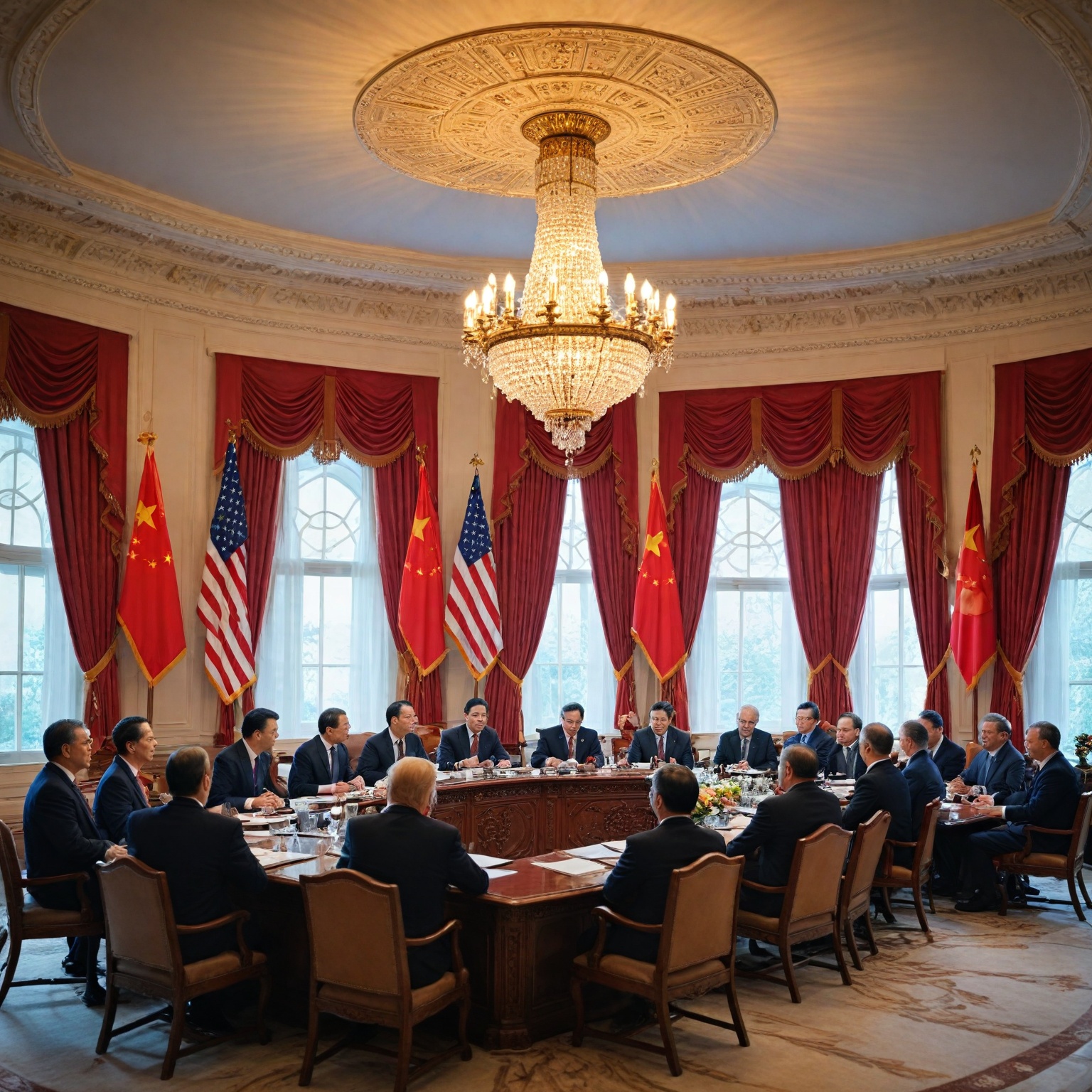
Summary
**Unlocking Potential: Donald Trump Considers Cutting China Tariffs to Soothe Trade Tensions** is a significant development in the ongoing trade dispute between the United States and China during Donald Trump’s second presidential term. The trade conflict, characterized by steep tariffs imposed by the U.S. on Chinese imports—reaching rates as high as 145%—and reciprocal measures from China, has led to escalating economic and diplomatic tensions between the world’s two largest economies. Trump’s consideration of tariff reductions marks a potential shift from aggressive protectionism toward negotiation and de-escalation, amid widespread concerns over economic disruption and global market instability.
The tariff strategy, originally aimed at addressing perceived unfair trade practices, intellectual property theft, and national security concerns, has had profound impacts on international trade and domestic industries. While some studies indicate that tariffs encouraged reshoring of manufacturing and strengthened sectors such as steel production in the U.S., they also contributed to higher consumer prices, disrupted supply chains, and retaliatory losses estimated in the billions of dollars. The trade war has further intensified geopolitical rivalry, complicating efforts to balance economic interests with strategic competition.
Diplomatic efforts to ease tensions have involved behind-the-scenes negotiations and tentative engagement by both Washington and Beijing, despite public rhetoric maintaining firm tariff stances. China has consistently demanded that the U.S. roll back tariffs before substantive talks can proceed, framing tariff removal as essential to restoring mutual trust. Meanwhile, Trump’s openness to considering tariff cuts reflects pressure from business leaders and economic realities, highlighting the complex interplay of domestic politics, economic strategy, and international diplomacy.
The proposal to reduce tariffs is notable for its potential to reshape U.S.-China trade relations and influence global economic stability. However, it remains controversial: both sides remain reluctant to concede on critical national security and economic issues, and the effectiveness of tariff reductions as a tool for negotiation is debated among experts. The outcome of these deliberations will likely have far-reaching implications for international trade policies, supply chain resilience, and the broader geopolitical landscape.
Background
During his second presidency, Donald Trump implemented a series of steep protective tariffs on imports into the United States, significantly escalating trade tensions with China. Between January and April 2025, the average effective U.S. tariff rate increased dramatically from 2.5% to approximately 27%, marking the highest level in over a century. Trump raised baseline tariffs on Chinese imports to 145%, prompting China to retaliate with tariffs of at least 125% on U.S. goods, along with export restrictions on rare earth elements critical to high-tech industries. The trade war intensified in mid-2018, with the U.S. sharply increasing tariffs on a wide range of imports. From July through September 2018, U.S. tariffs rose from 3.8% to 12.0%, while China’s tariffs increased from 7.2% to 18.3%. Additional tariff hikes followed, including measures targeting steel, aluminum, automobiles, and multiple rounds of tariffs on Chinese products between March and April 2019. These actions affected not only China but other trade partners, including Canada and Mexico, in response to issues related to trade agreements such as the USMCA.
Throughout this period, Trump frequently criticized China’s trade practices and imposed tariffs to protect American economic interests, although some economists argued that the U.S. trade deficit was driven more by macroeconomic factors than trade policy alone. His administration’s approach led to high economic uncertainty, with business leaders and financial markets voicing concerns over the sustainability of the tariffs and the risk of recession. Amid escalating tensions, both sides showed signs of willingness to engage in negotiations. China announced it was evaluating the possibility of starting trade talks with the U.S., a development that was welcomed by global markets. Discussions between U.S. officials, including National Security Adviser Jake Sullivan, and Chinese counterparts sought to stabilize relations and prevent conflict escalation. While public statements from both governments maintained a firm stance on tariff levels, behind-the-scenes diplomacy suggested a mutual interest in easing tensions.
President Trump, responding to internal and external pressures, including from prominent business figures like Tesla CEO Elon Musk, appeared to soften his rhetoric on China and the Federal Reserve’s Jerome Powell. Although he initially resisted tariff reductions, Trump indicated openness to a possible de-escalation, aiming to balance economic protectionism with the need to sustain trade flows and market stability.
Context of the Proposal
The proposal to consider cutting tariffs on Chinese imports arises amid ongoing trade tensions between the United States and China, characterized by high tariffs and retaliatory measures that have strained economic relations and supply chains. Both nations have demonstrated reluctance to concede on issues central to their national economic security, making negotiations a delicate process. China’s announcement of evaluating the possibility of tariff negotiations was a pivotal moment, as tariffs had reached astonishingly high levels—up to 245% on some Chinese exports—significantly throttling trade between the two largest global economies and raising concerns about a potential recession.
Under the Trump administration, tariffs were employed as tools to address perceived unfair trade practices by China and to bolster U.S. economic and national security interests. Executive actions, such as the 2017 Section 232 investigation, targeted imports of steel, aluminum, and critical minerals, aiming to reduce reliance on foreign sources and strengthen domestic industries. Reports indicate that tariffs helped stimulate reshoring of manufacturing and steel production in the U.S., reducing imports from China and encouraging domestic production with only minor impacts on consumer prices. However, studies also highlight that U.S. consumers have faced higher prices due to tariffs, and retaliatory tariffs from China resulted in export losses totaling billions of dollars, with the average American household projected to bear an increased tax burden from these trade policies.
The economic impact of the tariffs extends beyond immediate trade figures; disruptions to trans-Pacific supply chains and restrictions on critical raw materials, such as rare earth metals, have alarmed U.S. officials and complicated industrial operations. Furthermore, the trade war has underscored the broader strategic competition between the two countries, with the United States seeking to leverage tariffs and trade policy as instruments to restore national and economic security and achieve reciprocity in global markets. Despite these efforts, many countries remain cautious, given their economic interdependence with China and the complexities of decoupling industrial and technological ties.
Negotiations have also been influenced by diplomatic dynamics, where both the U.S. and China seek to frame any initial move to the negotiating table as a response rather than a concession, allowing each side to claim a form of victory amid the ongoing conflict. Overall, the proposal to reduce tariffs must be understood within this intricate context of economic pressures, national security concerns, international diplomacy, and the pursuit of strategic leverage in U.S.-China relations.
Details of the Proposal
The proposal under consideration involves the possibility of reducing tariffs imposed on Chinese goods to levels that existed prior to what has been referred to as “liberation day,” at least temporarily during negotiation periods. Alfredo Montufar-Helu, senior advisor to the China Center at The Conference Board, described the process as delicate, noting that both the United States and China are likely to be reluctant to make concessions on issues deemed critical to their national economic security. Montufar-Helu emphasized that a rollback of tariffs could provide significant relief to businesses on both sides, though it remains uncertain how receptive the Trump administration would be to such a proposal.
The tariffs in question have been a central component of President Donald Trump’s broader strategy to protect American industries and national security. Since early in his administration, Trump has employed tariffs as a lever to address trade imbalances and protect critical sectors. For example, the administration launched investigations under Section 232 of the Trade Expansion Act of 1962 into the national security risks posed by reliance on imported critical minerals and derivative products, leading to responsive tariffs aimed at bolstering U.S. resilience. Moreover, tariffs were increased significantly in 2018 and 2019 on imports from China and other countries, including steel, aluminum, and automobiles, with rates in some cases reaching as high as 245% on specific Chinese exports.
The administration’s stance has been that tariffs serve as an effective tool to reduce imports from China and stimulate domestic production, with studies indicating that these measures have strengthened the U.S. economy and led to reshoring in key industries such as manufacturing and steel production. Despite this, trade tensions have caused significant disruption to global markets, and diplomatic efforts have continued in parallel, including direct communications between President Trump and Chinese President Xi Jinping, as well as talks with other countries affected by U.S. protectionist policies.
Negotiations on tariff reductions would likely involve a complex balancing of strategic interests. Beijing’s goals include the rollback of competitive U.S. measures and the avoidance of further escalations, while Washington is focused on maintaining leverage to secure fair trade practices and national economic security. Possible complementary measures discussed in the broader trade dialogue include import quotas, government licensing requirements, and new safety or environmental standards aimed specifically at Chinese products.
Chinese Government Response
In reaction to the escalating tariff measures imposed by the United States under President Donald Trump, the Chinese government implemented a range of retaliatory actions aimed at demonstrating its resolve while leaving room for potential negotiations. These measures included export controls on critical minerals, the imposition of tariffs on U.S. agricultural products, adding U.S. companies to China’s unreliable entities list, initiating investigations into additional American firms, and filing complaints at the World Trade Organization (WTO). Such actions were carefully calibrated to respond firmly without completely closing the door to dialogue.
China’s Commerce Ministry has consistently maintained that negotiations would only be entertained if the United States first rolled back its unilateral tariffs on Chinese goods. The Ministry emphasized that failure by the U.S. to correct these tariff measures would indicate insincerity and further erode mutual trust between the two countries. This stance was reiterated amid growing signs that the tariffs had begun adversely affecting Chinese producers. Despite this, influential Chinese commentators and officials have occasionally signaled a readiness to engage in talks, which contributed to positive market reactions at various points.
Chinese officials have also repeatedly denied claims of ongoing tariff negotiations with the United States, stressing that any dialogue must occur on the basis of equality and mutual respect. Spokespersons from China’s Foreign and Commerce Ministries have dismissed suggestions of active negotiations, asserting that no economic and trade discussions on tariffs had taken place and cautioning the U.S. against threatening China. This firm position reflects a broader reluctance to make concessions on issues deemed vital to national economic security.
Analysts suggest that the complexity of the trade tensions, with both sides entrenched in their tariff policies, makes negotiations particularly delicate. China’s demands for the removal of U.S. tariffs to pre-conflict levels during negotiation periods aim to provide relief to businesses but face uncertainty regarding U.S. receptiveness. Moreover, experts have noted that further escalation tactics might yield limited effectiveness, with the core challenge remaining how to bring both parties to the negotiating table in good faith.
Reactions and Responses
Following the imposition of tariffs by the Trump administration, China implemented a series of coordinated retaliatory measures designed to signal its resolve while keeping the door open for negotiations. These measures included export controls on critical minerals, tariffs on U.S. agricultural products, the inclusion of U.S. companies on China’s unreliable entities list, investigations into other American firms, and filing a lawsuit at the World Trade Organization (WTO). Chinese officials have repeatedly urged the United States to cease threats and engage in dialogue on the basis of equality and mutual respect, though they have denied holding consultations or negotiations on tariffs.
The response from the United States was mixed. While some studies indicated that tariffs had bolstered the U.S. economy by encouraging reshoring of manufacturing and reducing imports from China, others highlighted adverse effects on U.S. consumers and industries. For example, a 2024 study found that tariffs strengthened the economy and stimulated industries like steel production, but a 2021 review concluded that U.S. consumers bore the cost of higher prices and that aggregate real income fell in both countries, albeit modestly relative to GDP. Retaliatory tariffs from China led to direct export losses estimated at $27 billion between 2018 and 2019, and tariffs were found to be largely passed through to U.S. prices, further impacting consumers.
Within the U.S., the tariff strategy faced opposition from labor unions and many congressional Democrats, who argued that China’s lax labor and environmental protections could encourage a “race to the bottom” in global standards. Despite these concerns, U.S. policymakers have pursued a more assertive stance toward China, citing the latter’s failure to fully comply with WTO rules. Experts noted that negotiations would be delicate, with both countries reluctant to make concessions on issues perceived as vital to national economic security. One key demand from the U.S. side would likely be a rollback of tariffs to pre-trade-war levels, at least during negotiations, though it remained unclear how receptive the Trump administration would be to such a proposal.
The announcement of potential trade talks initially boosted market sentiment in Shanghai and Hong Kong, though concerns remained regarding underlying economic weaknesses such as low consumer and business demand. The U.S. had expressed interest in negotiating, with the Chinese Foreign Ministry confirming that meetings were being held at the request of the U.S. side, yet both governments publicly maintained firm positions on tariffs. Meanwhile, economic indicators reflected some strain from the ongoing trade tensions; manufacturing indices showed contractions, and companies expressed anxiety about supply chain disruptions and shifting production away from China. The tariffs also contributed to a decline in the value of the U.S. dollar and prompted the International Monetary Fund to downgrade its global growth forecast for 2025.
Implications
The prospect of cutting tariffs on China holds significant implications for both the United States and China amid ongoing trade tensions. A primary consideration is the diplomatic framing of negotiations: a “looser understanding” of which side initiated dialogue could allow both leaders, including President Trump and President Xi, to claim a form of victory, thereby easing the path for tariff negotiations while maintaining political face.
Economically, tariffs have had mixed effects. While some studies indicate that the tariffs led to reshoring of manufacturing and steel production in the U.S., strengthening certain domestic industries, they have also contributed to higher consumer prices and reduced real incomes in both countries. Retaliatory tariffs from China and other trading partners have weakened U.S. exports—particularly agricultural goods—and pushed American businesses to divert imports from China to other countries, increasing the U.S. trade deficit in goods to record levels. Additionally, the tariffs generated substantial government revenue but at the cost of dampened economic output and lower tax income overall.
From a strategic standpoint, U.S. concerns about China’s acquisition of sensitive technology and intellectual property theft have driven much of the tariff policy, with the goal of curbing unfair competition and protecting national security. However, China’s swift and coordinated retaliatory measures—including export controls, investigations into U.S. firms, and WTO litigation—illustrate its resolve while still keeping negotiation channels open.
Both countries face economic strains, with China employing measures such as easing credit to buffer exporters as trade talks are anticipated. Despite the willingness to negotiate, the process remains delicate given that each side is reluctant to make concessions on issues tied to national economic security, such as tariff rates reverting to pre-conflict levels. Meanwhile, other nations impacted by U.S. protectionist policies are also seeking dialogue to mitigate adverse effects, reflecting broader global repercussions of the trade war.
Related Developments
Market reactions to developments in trade negotiations have been mixed. Initial news of economic boosts and planned China-U.S. trade talks led to early gains in Hong Kong and Shanghai share prices, with Shanghai’s Composite index extending those gains. However, the rally did not sustain in Hong Kong, partly due to underlying weak consumer and business demand. Analysts noted that easing lending conditions alone would be insufficient without broader fiscal support. Notably, the announcement of talks came amid both sides maintaining public stances against compromising on tariffs, though the U.S. had recently expressed interest in negotiating.
Studies have suggested that tariffs implemented during President Trump’s first term had significant economic effects. A
The content is provided by Jordan Fields, 11 Minute Read


