
Summary
Ordos is a resource-rich city located in northern China, renowned as one of the nation’s wealthiest coal production hubs. Situated within the Ordos Basin, it possesses vast coal reserves that have historically underpinned its rapid economic growth and industrial development, transforming it into a pivotal energy base. Over recent decades, Ordos has evolved from a traditional mining town into a modern urban center, marked by ambitious infrastructure projects such as the Kangbashi New District and extensive industrial zones dedicated to coal chemical processing and heavy industry.
In response to mounting environmental challenges and global climate goals, Ordos is pioneering innovative approaches to transition from a high energy consumption economy to one driven by sustainable industrial innovation. The city leads the integration of advanced technologies including underground coal gasification (UCG), green hydrogen production, carbon capture, utilization, and storage (CCUS), as well as the deployment of renewable energy systems like large-scale solar and wind power. These initiatives collectively form the “Ordos Model,” a coordinated strategy emphasizing pollution control, carbon emissions reduction, and ecological restoration that positions the city as a national pilot for green industrial transformation.
Ordos’s urban development and social transformation present both achievements and controversies. While the Kangbashi District was designed as a showcase of modernity and economic diversification, it gained international attention as a “ghost city” due to an oversupply of unoccupied real estate following a property market downturn and falling coal prices. The city’s ongoing efforts to manage this legacy include relocating former rural residents, expanding smart infrastructure, and fostering new economic sectors beyond coal, reflecting broader challenges faced by resource-dependent regions amid economic restructuring.
Looking forward, Ordos exemplifies the complex balance between sustaining economic growth, promoting environmental sustainability, and ensuring social equity in a resource-based city. Through coordinated government policies, technological innovation, and adherence to international frameworks for just transition, Ordos aims to serve as a model for other coal-dependent regions navigating the path toward a cleaner, more diversified energy future.
Geography and Location
Ordos is situated in northern China and features a diverse topography that can be broadly divided into several distinct geographical zones. The eastern part of Ordos is characterized by hilly terrain, while the western and central regions consist of high plateaus. To the north and south lie expansive sandy deserts, and the southern bank of the Yellow River features plains. The elevation varies significantly across the area, with the highest point reaching 2,149 meters (7,051 feet) in the west and the lowest point at 850 meters (2,790 feet) in the east.
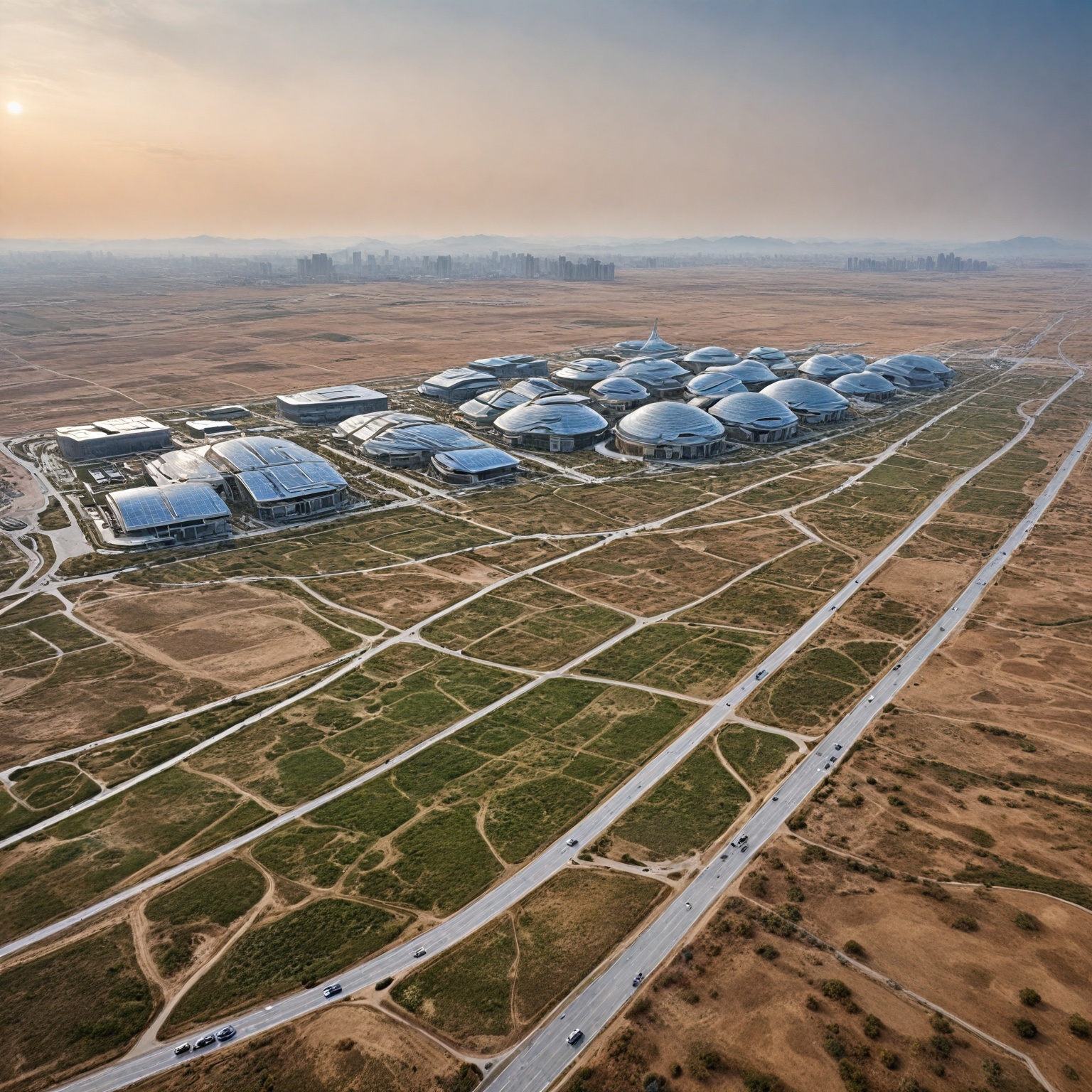
The urban landscape of Ordos includes the older city as well as the newer development area formed by the Kangbashi District and the adjacent township of Altan Xire. Kangbashi lies to the north of the Wulan Mulun River, a tributary of the Yellow River, whereas Altan Xire is situated to the south of this river. These areas are connected by a well-maintained expressway that exemplifies the region’s rapid urban development this century.
Moreover, Ordos is part of a broader regional context marked by its proximity to key natural resources and ecological zones. The Kubuqi Desert, located in the northern part of Ordos, has been the focus of significant ecological restoration efforts, transforming once barren desert into green oasis through sustained afforestation and sand control projects over the past 75 years. This reflects the region’s strategic importance not only in terms of resource wealth but also in environmental innovation and sustainability.
Historical Background
Ordos, located in northern China, emerged from a mining boomtown into a significant urban center through a long-term developmental timeline that paralleled similar urbanization trends across the country. The city’s rapid growth was primarily driven by large-scale surface coal mining following China’s economic reforms starting in 1978, which transformed Ordos into the nation’s “coal capital” within a few decades. This resource-driven expansion dramatically increased its per capita GDP, elevating it from one of the lowest to surpassing even Hong Kong by 2009.
A notable feature of Ordos’ development is the creation of the Kangbashi district, the city’s new central area designed to project modernity and prosperity. Kangbashi was built with landmarks such as museums, theaters, and cultural centers to symbolize the city’s economic strength and attract industries beyond coal mining. The district’s inhabitants largely consist of former farmers who were relocated from their lands by government initiatives, reflecting broader social shifts since Mao’s Cultural Revolution when urban youths were sent to rural areas.
While coal remains the backbone of Ordos’ economy, the mining boom also facilitated the growth of ancillary sectors like heavy industry and chemical manufacturing, supported by the establishment of multiple province-level and municipality-level industrial zones since 1998. These zones cover over 700 square kilometers and were planned to accommodate expanding industrial activities reliant on the region’s abundant and affordable energy resources. The Ordos Basin’s rich Upper Paleozoic coal-bearing strata have provided high-quality source rocks and reservoirs, contributing to the city’s coalbed methane potential and sustaining its energy output.
In recent years, Ordos has begun shifting from a traditional high energy consumption economy toward high-value industrial innovation. Technological advancements such as underground coal gasification and integration of modern coal chemistry with green hydrogen production are part of this transition. By the end of 2023, Ordos and its industrial parks—Otog High-tech Industrial Development Zone and Sulige Economic Development Zone—were selected among China’s first pilot cities for pollution and carbon reduction innovation, aiming to balance industrial growth with environmental sustainability between 2024 and 2026.
Economic Significance
Ordos has long been recognized as a key coal production center in northern China, boasting coal reserves that account for about one-sixth of the nation’s proven reserves, most of which are amenable to opencast mining. Its rich coal resources have underpinned the city’s traditional economic foundation, fostering large-scale surface coal mining and related industries such as coal chemical projects, coal to oil, coal to gas, and methanol olefins production. This has made Ordos the most concentrated area of coal chemical projects globally, forming multiple integrated industrial chains that significantly enhance the added value of its resource base.
In recent years, Ordos has leveraged its coal wealth to transition toward a more diversified and modern energy economy. The city has emerged as a pioneer in integrating coal with renewable energy sources, particularly hydrogen and energy storage technologies, thereby carving a new path from “high energy consumption” to “high value” industrial innovation. Notably, Ordos has developed 18 key industrial chains, including green hydrogen production and new energy heavy trucks, supported by advanced projects that combine modern coal chemistry with carbon capture, utilization, and storage (CCUS). The city’s installed renewable energy capacity has surpassed 20 million kilowatts, representing over 35 percent of its total power generation, and its new energy equipment manufacturing sector has seen a surge in added value by 261.3 percent, fostering a comprehensive and sustainable hydrogen energy ecosystem.
Efforts to modernize coal usage include adopting advanced technologies such as supercritical air-cooled power generation units with low energy and water consumption for new coal-fired plants, alongside environmental protection measures like desulfurization and denitrification retrofits in existing facilities. At the Heidaigou open-pit coal mine, automation is transforming operations with fleets of 300-ton unmanned trucks and remote-controlled equipment, reflecting Ordos’ push toward fully automated mining.
Beyond coal, Ordos is actively promoting renewable energy development and energy system optimization. Strategic initiatives include constructing smart grids, deploying electrolysers to produce green hydrogen that reduces coal consumption in industry, and establishing large-scale energy storage and battery plants. These advancements are part of the broader “Ordos Model,” which emphasizes pollution reduction, carbon emissions control, industrial upgrading, and ecological value monetization, setting an innovative example for balancing economic growth with environmental sustainability.
Despite the importance of coal mining and petrochemicals, Ordos is gradually diversifying its economy to include high-tech manufacturing, renewable energy industries, and tourism, aiming to reduce its overreliance on resource extraction and create a more sustainable economic future. This economic transformation is crucial not only for maintaining Ordos’ position as a national energy base but also for addressing environmental challenges such as water scarcity and land degradation inherent to the region’s semi-arid climate.
Innovations and Technological Advancements
Ordos has been at the forefront of integrating environmental governance with technological innovation, particularly in the areas of pollution control, carbon reduction, and clean energy development. Moving beyond traditional “end-of-pipe treatment,” the city is optimizing its environmental management by establishing a pioneering mechanism that synergizes pollution control with carbon reduction efforts. This approach, known as the “Ordos Model,” emphasizes coordinated management strategies, including the control of multiple greenhouse gases such as carbon dioxide and methane, alongside breakthroughs in energy structure transformation, industrial technology upgrades, and green transportation alternatives.
A significant technological focus in Ordos involves underground coal gasification (UCG), which transforms the underground coal seam into a natural reactor for gasification, eliminating the need for conventional mining and surface gasifier vessels. This method presents substantial cost-saving advantages and potential environmental benefits, especially when combined with carbon dioxide sequestration techniques. UCG is recognized as a disruptive technology and is part of a broader set of 12 key technological developments planned for the region, including green coal mining, ecological protection, intelligent mine construction, ultra-supercritical power generation, and carbon capture, utilization, and storage (CCUS).
In addition to UCG, Ordos is advancing the production and utilization of green hydrogen as a means to reduce coal consumption in industry. Projects are underway to generate green hydrogen using abundant local solar and wind resources. For example, an initiative featuring 10 electrolysers (each with a capacity of 1,000 Nm³/h) aims to produce approximately 30,000 tons of green hydrogen annually. This green hydrogen will be used to partially replace coal in nearby chemical processing, promoting cleaner and more efficient use of coal and supporting the integrated development of the hydrogen energy industry alongside traditional synthetic materials production. This project leverages advanced wind and photovoltaic power generation technologies and addresses challenges associated with renewable energy supply variability.
Energy system optimization in Ordos also involves reducing reliance on thermal power generation due to its pollution and water demand, while promoting wind power and other clean energy technologies. The city encourages scientific and technological innovation to lower clean energy production costs and improve economic viability. Smart grids are being developed to coordinate renewable energy distribution and storage, exemplified by an 8 GWh/year energy storage and battery plant, with phased implementation beginning in 2021.
Renewable energy development is closely linked with ecological restoration in Ordos. The Kubuqi Desert project exemplifies this integration, combining large-scale photovoltaic power generation with sand control and afforestation efforts. The 2-million kW photovoltaic sand control project, a collaboration between China Three Gorges Renewables Co and Elion Clean Energy Co, achieved full grid connection in 2023. Furthermore, a 3-gigawatt solar power station on a coal mining subsidence zone became operational in late 2024, representing the largest single-capacity solar power base of its kind in China. These initiatives not only generate clean electricity but also combat desertification and support sustainable land management, contributing to the restoration of millions of hectares of degraded land in the region.
Urban Planning and Infrastructure Development
Ordos, particularly its Kangbashi New District, stands as a flagship project in China’s ambitious urbanization efforts aimed at accommodating an influx of residents into modern cities. The district was originally conceived in the 1990s as an industrial zone but was re-envisioned in 2001 as a comprehensive new town to serve as a twin city to Dongsheng, featuring a broad spectrum of urban functions along with extensive cultural and leisure amenities. This transformation aligned with China’s broader “National New-Type Urbanization Plan,” which targeted raising the urban population to 60 percent by 2020, requiring the relocation of approximately 100 million people to urban areas nationwide.
The infrastructure of Kangbashi was designed to impress and project an image of prosperity and modernity, with landmarks such as museums, theaters, and cultural centers intended to attract non-coal industries and promote a livable urban environment. A perfectly landscaped expressway connects the old and new parts of Ordos, symbolizing the city’s rapid expansion into newly developed areas. Most residents in Kangbashi are former farmers who relocated after the government purchased their land, reflecting a significant social shift from rural to urban lifestyles.
However, the urbanization process faced considerable challenges. Following the 2011 burst of a real estate bubble and a simultaneous decline in coal prices linked to China’s economic slowdown, Ordos experienced an oversupply of unoccupied residential and commercial buildings. This phenomenon led to global media labeling the city a “ghost town,” underscoring the risks associated with rapid, speculative urban expansion.
To diversify its economy and support urban growth, Ordos developed four industrial parks aimed at overcoming infrastructure barriers that previously hindered resource export and industrial development. These efforts were part of a broader strategy to reduce dependence on coal mining and alleviate the associated environmental pollution. The city’s industrial planning incorporated high-tech, energy-saving, and environmentally friendly smelting projects, forming integrated industrial chains that promote circular economy principles and sustainable growth.
Digital technology and smart infrastructure also play a pivotal role in Ordos’s urban and industrial evolution. The Ordos Industrial Internet Platform exemplifies this trend, with plans to connect 68 intelligent mines by the end of the current year and expand to 160 by 2025. This connectivity enables intelligent coal production and creates a smart ecosystem linking mines with industrial partners. Moreover, Ordos’s empty boulevards have become a testing ground for autonomous vehicles, including self-driving trucks hauling coal, positioning the city at the forefront of smart mobility innovation.
Government Policies and Strategic Initiatives
The provincial people’s government holds overall responsibility for the sustainable development of resource-based cities like Ordos, while the city government focuses on creating and implementing economic transformation plans. Key government efforts include addressing unemployment, eradicating poverty, improving social security, relocating and reconstructing shanty towns, managing coal mining subsidence areas, and enhancing environmental protection. These tasks are integral to the performance evaluations of government officials across all levels, emphasizing accountability in sustainable urban development.
Reflecting broader shifts in China’s economic strategy, Ordos is aligning itself with Beijing’s vision of a modern, tech-driven economy. This includes autonomous driving initiatives and positioning local industries within the national framework of innovation and modernization. At the forefront of environmental policy, Ordos and two of its industrial parks—the Otog High-tech Industrial Development Zone and the Sulige Economic Development Zone—were selected at the end of 2023 among China’s first pilot cities and industrial zones for pollution and carbon reduction innovation. The pilot program, running from 2024 to 2026, aims to develop best practices balancing industrial growth with environmental responsibility through management innovation, adoption of advanced technologies, and coordinated control of greenhouse gases such as carbon dioxide and methane. This initiative has yielded significant progress in energy structure transformation, industrial technology upgrades, green transportation, environmental improvements, and ecological value monetization, gradually forming the distinctive “Ordos Model” for pollution and carbon reduction innovation.
The city’s policies also emphasize the reduction of thermal power generation due to its high pollution and water demand, advocating for energy system optimization and upgrades. This approach includes reforming new energy technologies to lower production costs while decreasing primary energy production. A flagship project in Ordos harnesses its abundant solar and wind resources to produce green hydrogen and oxygen, with an annual output of 30,000 tons of green hydrogen and 240,000 tons of green oxygen. This clean energy is utilized in carbon reduction efforts at the nearby Zhongtian Co-creation Ordos Coal Deep Processing Demonstration Project, showcasing a practical application of green hydrogen in industry. Additionally, Ordos is home to the world’s first zero-carbon industrial park, which operates entirely on renewable energy sources like solar and wind power. Equipped with cutting-edge green technologies, energy-efficient buildings, and waste-recycling systems,
Social and Cultural Aspects
Ordos, despite being predominantly rural, exhibits a complex social and cultural fabric shaped by its historical development and recent rapid urbanization. The region’s culture reflects a long-term transmutation process that intertwines Hetao civilization with the Yellow River civilization, highlighting the significant influence of both Urad and Ordos Mongolian cultures. Hetao culture, an important component of the northern grasslands’ mainstream culture, serves both as a source and a stream within the broader grassland cultural milieu, demonstrating a symbiotic relationship with the northern grassland traditions.
The social transformation of Ordos is closely tied to the development of Kangbashi District, which was constructed as a symbol of modernity and prosperity. Intended to attract industries beyond coal, Kangbashi was designed with expansive cultural centers, museums, and theaters to project an image of a world-class city. However, the 2012 global coal price crash and China’s property market downturn left more than 70% of Kangbashi’s properties unfinished, leading to a population that is smaller than initially anticipated. Today, only about 131,000 residents live in Kangbashi, while the greater Ordos area houses approximately 2.2 million people across a vast area, resulting in a low population density.
The demographic composition of Kangbashi includes many former farmers who were persuaded by the government to relocate to apartment buildings in the new town. This shift marks a significant social transition from traditional rural livelihoods to urban living, reflecting broader patterns in China’s development. These new citizens are neither elites nor urban arrivistes but represent a population adapting to rapid socio-economic changes. This process echoes historical population movements such as those during Mao’s Cultural Revolution when urban youths were relocated to rural areas, illustrating the ongoing interplay between urban and rural identities in the region.
In the context of economic transition and environmental policy, Ordos shares common challenges with other coal-dependent cities in China. Studies on cities like Wuhai and Tongchuan highlight how central government policies emphasize a “just transition,” aiming to achieve sustainable development while securing livelihoods and employment during the gradual reduction of coal dependency. Although the term “just transition” originated outside China and was not widely used domestically until recently, it has become a guiding principle in policy implementation, including in regions such as Ordos that face similar coal-related economic shifts.
Economic and Social Impacts of Technological Innovations
Technological innovations in Ordos have played a crucial role in addressing both economic and social challenges, especially amid the city’s ongoing transition from a coal-dependent economy to more sustainable industries. These innovations have supported significant breakthroughs in energy structure transformation, industrial technology upgrades, and environmental improvements, forming what is known as the “Ordos Model” for pollution and carbon reduction innovation.
Economically, technology acts as a vital driver of development, fostering creative destruction that can lead to improved quality of life and new growth opportunities. This perspective aligns with broader views that see innovation as essential to overcoming global challenges such as climate change, famine, and disease. In Ordos, these innovations contribute to diversifying the economy and reducing reliance on coal, while encouraging the monetization of ecological value, which further supports sustainable growth.
Socially, the impacts of technological change are closely intertwined with efforts to ensure a just transition for communities historically dependent on coal industries. The provincial government holds overall responsibility for the sustainable development of resource-based cities like Ordos, while city authorities implement economic transformation plans that address unemployment, poverty eradication, social security improvements, and environmental protection. Such social measures are critical in managing the consequences of industrial shifts, as new industries often struggle with innovation deficits and talent attraction, challenges that are expected to intensify as China accelerates its decarbonization efforts.
In addition to economic restructuring, food security remains a key concern where technology also plays a significant role. Ordos is focused on increasing food production by protecting arable land and stabilizing the planting area of food crops, alongside improving planting technologies to maximize land resource utilization. These agricultural innovations are essential to sustaining the local population and complement the city’s broader sustainable development goals.
The social dimension of technological innovation in Ordos further extends to urban sustainability initiatives, mirroring global trends seen in smart city projects. While not detailed extensively in Ordos itself, examples from cities worldwide, such as Amsterdam’s smart city platform and Shanghai’s bike-sharing programs, highlight the importance of citizen participation and green infrastructure in urban innovation. These approaches offer valuable models for Ordos as it seeks to integrate social inclusivity and environmental sustainability into its technological advancements.
Challenges and Future Prospects
Ordos, historically a wealthy coal hub in northern China, faces significant challenges as it navigates the transition toward a sustainable and diversified economy. The city’s reliance on coal mining has made it vulnerable to the socio-economic impacts of decarbonization, including unemployment and environmental degradation, which require carefully coordinated policy responses. The urgency of addressing these issues is heightened by the broader national push for net-zero emissions and the associated transformation of energy systems.
One of the principal challenges is managing the socio-economic transition for workers and communities dependent on coal mining. Lessons from coal regions in China emphasize the importance of tailored, region-specific approaches, where local governments bear responsibility for economic restructuring, social security enhancement, and environmental restoration. The integration of employment solutions, poverty eradication, and urban redevelopment into government performance evaluations exemplifies this comprehensive approach. Additionally, international frameworks such as the International Labour Organisation’s Guidelines for a Just Transition offer policy blueprints to ensure that energy transitions promote social inclusiveness and decent work, underscoring the need for workforce planning and skills development aligned with future job opportunities.
Environmental governance and industrial innovation remain focal points for Ordos’s future prospects. The city is advancing a model that coordinates pollution control with carbon reduction, aiming for synergistic environmental benefits rather than isolated end-of-pipe treatments. This “Ordos Model” has facilitated breakthroughs in energy structure transformation, industrial technology upgrades, and the monetization of ecological value. Emphasis on green transportation alternatives and integrated projects—such as combining modern coal chemistry with green hydrogen and carbon capture, utilization, and storage (CCUS)—positions Ordos as a pioneer in clean energy innovation.
Moreover, Ordos’s commitment to developing a hydrogen energy ecosystem is evidenced by the rapid growth of its new energy equipment manufacturing sector and the expansion of renewable energy capacity, which now accounts for over 35 percent of its total power generation. Policy support for management innovation and coordinated control of multiple greenhouse gases further enhances its transition trajectory. These advancements align with national initiatives, including pilot projects for hydrogen/ammonia blending and 100 percent hydrogen-fired turbines, aimed at creating closed-loop energy systems that reduce renewable curtailment and stabilize grids.
Technological innovation, such as underground coal gasification (UCG), offers additional avenues for resource utilization by enabling access to coal seams previously deemed uneconomical. UCG could significantly expand economically recoverable coal reserves, presenting both opportunities and environmental considerations in the city’s energy portfolio. Furthermore, research on coal distribution and unconventional resource exploration in the Ordos Basin informs strategic planning for resource development.
Looking ahead, Ordos’s transformation exemplifies the complexities of building sustainable urban and industrial systems from a coal-dependent foundation. The city’s experience highlights the need for integrated approaches that balance economic diversification, environmental sustainability, and social equity, providing valuable lessons for other resource-based regions undergoing similar transitions. Continued innovation, robust policy frameworks, and inclusive socio-economic strategies will be critical to overcoming the challenges and realizing the future prospects of Ordos as a model for clean energy and sustainable development.
The content is provided by Blake Sterling, 11 Minute Read


