Summary
Huawei is set to begin production at a newly constructed Chinese semiconductor factory that will manufacture its next-generation AI chips, marking a significant milestone in China’s push for domestic semiconductor self-sufficiency. The facility, developed with close ties to Huawei and supported by local government initiatives, utilizes Semiconductor Manufacturing International Corporation’s (SMIC) N+2 7 nm process node to produce advanced AI processors such as the Ascend 910C. This effort represents a strategic response to U.S. export restrictions that have limited Huawei’s access to cutting-edge foreign technology and manufacturing equipment, particularly extreme ultraviolet (EUV) lithography tools.
The factory is part of a broader ecosystem including spin-off firms like SiCarrier and SwaySure, which focus on domestic development of semiconductor manufacturing tools to reduce reliance on foreign suppliers amid ongoing geopolitical tensions. Despite these advances, Huawei’s AI chips currently face challenges with low yield rates—estimated around 20% to 40% in early 2024—and continue to depend on foreign-sourced equipment from companies such as ASML, Lam Research, and Applied Materials. Nevertheless, the Ascend 910C and related products have demonstrated competitive capabilities in AI inference workloads, supporting large-scale deployments like Huawei’s CloudMatrix 384 AI system and powering flagship devices such as the Mate 60 Pro smartphone.
Huawei’s AI chip production is notable for its role in China’s broader semiconductor strategy, which aims to build an integrated domestic supply chain for critical technologies despite stringent U.S. trade controls. These export restrictions prohibit the sale of advanced node manufacturing equipment, yet Huawei has partially circumvented limitations through indirect sourcing and partnerships, including support from South Korean firms. The company’s progress underscores ongoing geopolitical and commercial controversies, with Western governments scrutinizing indirect technology transfers and supply chain collaborations that may undermine export controls.
Looking ahead, Huawei plans to scale production substantially, targeting 100,000 units of the Ascend 910C chip and 300,000 units of its predecessor Ascend 910B by 2025, contingent on improvements in manufacturing yield and capacity. While the technology currently lags behind global leaders such as NVIDIA and TSMC in raw compute performance and ecosystem maturity, Huawei’s integrated approach to AI chip development—spanning computing architecture, data storage, and networking—positions it as a pivotal player in China’s drive for semiconductor independence and AI innovation.
Background
Huawei has emerged as a central figure in China’s semiconductor ambitions, leading efforts to develop a domestic chip manufacturing ecosystem amid geopolitical tensions and supply chain restrictions. The company is spearheading the creation of local alternatives to advanced technologies from global industry leaders such as NVIDIA, ASML, SK hynix, and TSMC. This drive is motivated by Huawei’s placement on the US Entity List, which has limited its access to cutting-edge foreign components and equipment, compelling the firm to push for self-sufficiency with strong support from both national and local Chinese governments.
Construction of new chip manufacturing facilities, including the SwaySure and SiCarrier plants, began in 2022, with these factories rapidly taking shape according to satellite imagery. SiCarrier, originally a Huawei lab spin-off rumored to be backed by a Shenzhen state fund, made a significant public debut by showcasing around 30 chipmaking tools—ranging from etching to testing and deposition equipment—at the 2023 Semicon conference in Shanghai. This indicates a strategic effort to build an integrated semiconductor supply chain domestically.
Huawei’s chip development efforts include collaboration with Semiconductor Manufacturing International Corporation (SMIC), China’s leading contract chipmaker. SMIC has produced the 910C processor using its N+2 process node, although the chip’s yield remains limited to approximately 20% due to challenges related to advanced lithography equipment shortages. Despite these limitations, the SMIC-made processor notably powered Huawei’s Mate 60 Pro smartphone, which was lauded domestically as a major milestone in indigenous semiconductor fabrication. This achievement was seen as a symbolic leap forward for China’s chip industry, even though the processor still lags several generations behind the most advanced global counterparts and relies partially on foreign manufacturing machinery, including Dutch ASML equipment and tools from Lam Research and Applied Materials.
The push to develop AI-focused chips is also a key element of Huawei’s semiconductor strategy. The company aims to harness the opportunities presented by the AI revolution by innovating across computing architectures, data storage, and network technologies. However, US restrictions on AI chip exports to China continue to hamper progress, meaning that mainland China is expected to trail behind in semiconductor process nodes for the foreseeable future. Nonetheless, Huawei’s advances have stimulated broader support within the Chinese technology sector to develop new hardware and software solutions that contribute to national chip self-reliance.
The Chinese Chip Factory
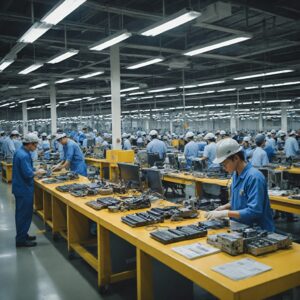
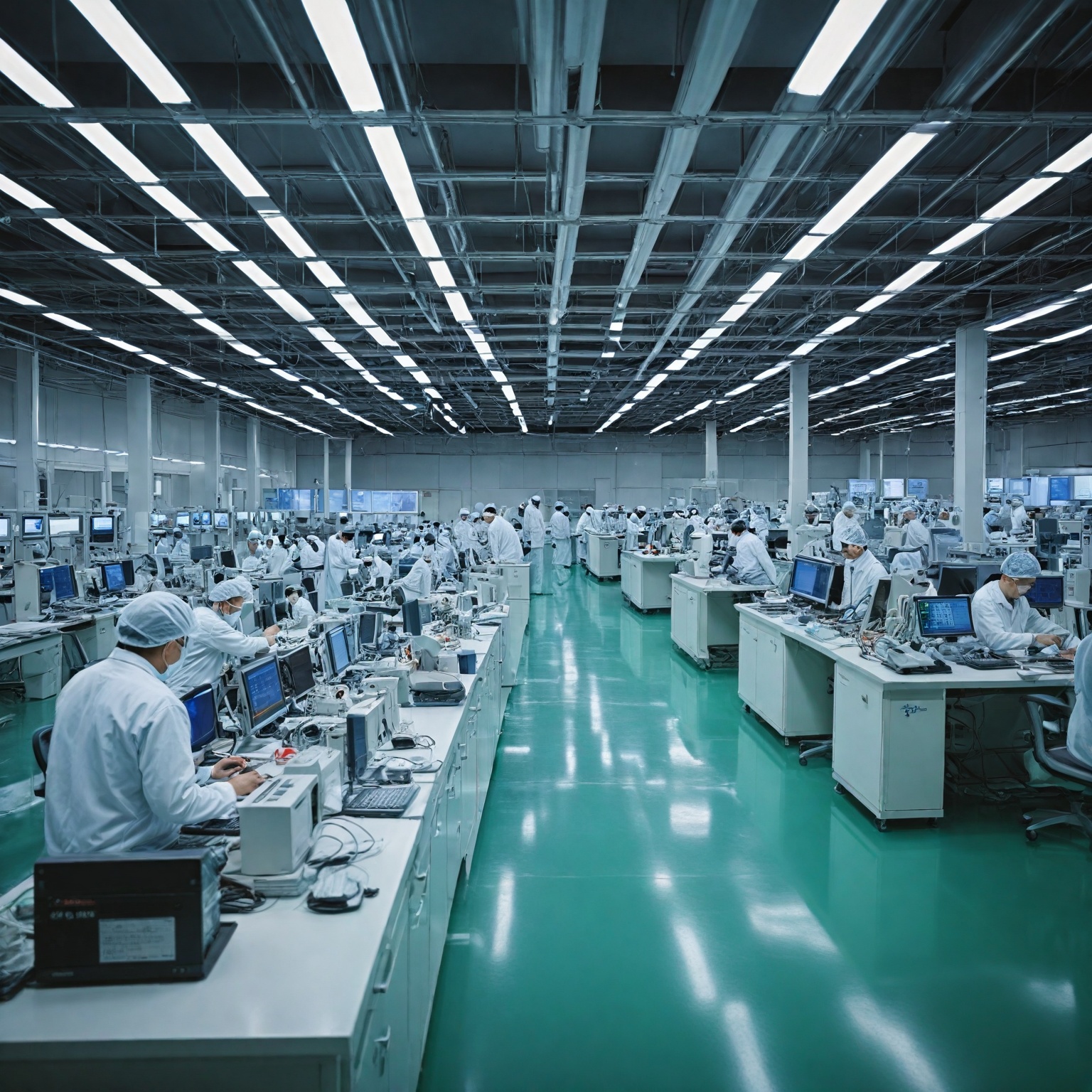
China’s ambitions to produce advanced AI chips have centered around the development of new semiconductor manufacturing facilities closely tied to Huawei and its supply chain. The factory poised to launch production of Huawei’s AI chips is reported to be located near other Chinese foundries such as Pengxinwei (PXW) and Shenzhen Pensun (PST), both integral parts of Huawei’s broader chip supply ecosystem. This site has rapidly taken shape since construction began in 2022, with satellite imagery confirming significant progress on associated plants like SwaySure and SiCarrier, the latter reportedly spun out of a Huawei lab and backed by a Shenzhen state fund.
The factory utilizes SMIC’s N+2 process, enabling Huawei to manufacture AI chips without relying on extreme ultraviolet (EUV) lithography tools, which are currently restricted under U.S. export controls. Despite this workaround, production still depends on foreign-sourced equipment from companies such as Dutch ASML and U.S.-based Lam Research and Applied Materials, highlighting ongoing reliance on global technology despite export restrictions. The machinery at these facilities remains difficult to maintain due to a shortage of skilled engineers and hesitancy from global equipment suppliers wary of violating sanctions, resulting in higher failure rates and lower chip yields.
The factory is anticipated to produce advanced node chips, including those based on the 7 nm process critical to Huawei’s Kirin mobile chips and Ascend AI processors, although China’s semiconductor technology remains behind global leaders like TSMC and Samsung. U.S. export restrictions have targeted advanced node semiconductor production, prohibiting sales of critical manufacturing equipment for logic chips at or below 16 nm, but loopholes and indirect supplies from South Korean and other international firms have somewhat mitigated these constraints. Korean companies, in particular, have been reported to supply subsystems and spare parts while also assisting in training Chinese engineers on equipment maintenance and fab operations.
This facility and its associated companies represent part of a broader Chinese strategy to vertically integrate semiconductor production and reduce dependence on foreign technology. Alongside efforts to build supply chains for specialized markets such as electric vehicles, Huawei’s close cooperation with domestic manufacturers poses challenges to Western firms seeking clarity on their collaboration and supply arrangements. The factory’s production of Huawei’s next-generation AI chips, including the upcoming Ascend 910C and future 5 nm process AI processors, is viewed as a critical step in China’s semiconductor development despite ongoing hurdles.
Production Capabilities and Technology
Huawei is preparing for mass production of its new AI chip, the Ascend 910C, with plans to begin manufacturing in the first quarter of 2025. This marks a significant milestone in the company’s chipset development, demonstrating progress despite ongoing challenges related to yield rates and manufacturing capacity. The Ascend 910C is produced using SMIC’s N+2 process, a second-generation 7 nm fabrication technology. However, the chip currently suffers from a low yield rate of approximately 20%, which is substantially below the over 70% yield needed for commercial viability in advanced semiconductor manufacturing.
Huawei’s previous generation Ascend 910B chip, also manufactured by SMIC, achieved a yield rate of around 50%, which still forced Huawei to reduce production targets and delay fulfilling orders from major clients. The limited availability of advanced lithography equipment, such as ASML’s EUV machines, restricts yield improvement and efficiency gains for these advanced node chips. The 7 nm process node used in these chips represents a mature yet technologically demanding fabrication standard, typically requiring cutting-edge tools to reach industry-standard yield rates.
Despite these production challenges, Huawei aims to scale up output significantly. Production targets include manufacturing 100,000 units of the Ascend 910C and 300,000 units of the older 910B chip in 2025, up from zero and 200,000 units respectively in 2024. The company has achieved an improvement in yield rates from 20% in early 2024 to 40% by late 2024, with an ambitious goal of reaching 60% by 2025. The 40% yield milestone already marked the first time Ascend chip production became profitable, a critical step toward greater scalability and long-term viability.
Huawei’s chip production strategy involves leveraging SMIC’s capabilities while facing export restrictions and technology access limitations imposed by U.S. authorities. These export controls limit the availability of advanced manufacturing equipment and materials, posing ongoing challenges for improving chip yields and expanding capacity. In response, Huawei has explored supplemental production from Taiwan’s TSMC, although U.S. export controls have constrained access to TSMC’s most advanced processes, forcing Huawei to prioritize strategic government and corporate customers.
In terms of technical performance, the Ascend 910C chip is fabricated using a 6 nm process node variant and is expected to deliver over 900 teraflops of BF16 performance per card, with 4 Tbps of memory bandwidth. Huawei has also introduced the AI CloudMatrix CM384 solution, which integrates 384 Ascend 910C processors across multiple racks to provide scalable compute and networking capabilities.
The production of these chips is viewed domestically as a significant achievement in indigenous semiconductor manufacturing, enabling Huawei to power flagship products like the Mate 60 Pro and fostering patriotic consumer support within China. Nonetheless, the technology remains several generations behind global industry leaders, as advanced manufacturing equipment still relies on foreign technology from companies such as ASML, Lam Research, and Applied Materials.
To mitigate supply chain risks and advance its technological independence, Huawei is linked indirectly to companies like SiCarrier and SwaySure, which have emerged to develop semiconductor manufacturing tools and components domestically. These firms have rapidly expanded their production capabilities, debuting a range of chipmaking equipment including etching, testing, and deposition tools, reflecting broader efforts to reduce reliance on foreign suppliers amid ongoing export restrictions.
AI Chip Models Manufactured
Huawei’s AI chip production primarily revolves around the Ascend series, with the Ascend 910C being the flagship model slated for mass production beginning in early 2025. The Ascend 910C is an enhanced version of the earlier Ascend 910B chip, offering significant performance improvements aimed at competing with Nvidia’s high-end GPUs. It is fabricated using SMIC’s second-generation 7nm (N+2) process node and features a single compute chiplet design, distinguishing it from initial reports suggesting a multi-chiplet layout.
The Ascend 910C delivers approximately 60% of the inference performance of Nvidia’s H100 GPU, positioning it as a competitive option particularly suited for inference workloads rather than large language model training. It boasts 128GB of HBM3 memory, surpassing the H100’s 80GB, and offers a memory bandwidth of 4Tbps, which is advantageous for handling very large AI models. The chip’s estimated BF16 compute capability exceeds 900 teraflops per card.
In addition to the chip itself, Huawei has developed the CloudMatrix 384 solution, a rack-scale AI system that integrates 384 Ascend 910C processors distributed across 16 racks. This architecture competes directly with Nvidia’s rack-scale solutions, incorporating innovations in networking, optics, and software to enhance system-level performance and efficiency. The CloudMatrix-Infer platform built on this infrastructure has demonstrated superior performance in running DeepSeek’s 671-billion-parameter R1 reasoning model, reflecting Huawei’s push to overcome challenges posed by US trade restrictions and sanctions.
Huawei aims to scale production significantly, targeting 100,000 units of the Ascend 910C and 300,000 units of the Ascend 910B by 2025, up from no 910C units and 200,000 units of the 910B in 2024. Yield rates have been improving, reaching 40% profitability by late 2024 with an ambitious goal of 60% yield by 2025, aligning with industry standards. The Ascend 910C combines two 910B processors into one package, enhancing cost-efficiency while delivering between 60% and 80% of Nvidia H100’s inference performance.
While the Ascend 910C excels in power efficiency and memory capacity, it currently trails Nvidia’s H100 and AMD’s MI300X in raw compute performance and ecosystem maturity. Nevertheless, it offers a viable domestic alternative for China’s AI computing needs, emphasizing synergistic innovation across computing, storage, and networking to harness available process nodes effectively.
Performance and Market Position
Huawei’s Ascend 910C AI chip is positioned as a significant contender in the AI semiconductor market, particularly within China’s domestic industry. The chip features 128GB of HBM3 memory, exceeding NVIDIA’s H100 GPU which has 80GB, offering advantages for very large AI models. While the NVIDIA H100 generally leads in raw compute performance and benefits from the mature CUDA ecosystem, the Ascend 910C aims to compete especially in power efficiency and specific workloads such as inference tasks. It is being adopted by leading Chinese technology companies including Baidu and ByteDance to power advanced AI models like DeepSeek R1.
Despite these strengths, the Ascend 910C faces challenges in achieving production scalability and yield rates, with current production capacity reportedly at only 20% due to difficulties stemming from U.S. trade restrictions and technological hurdles. Huawei relies heavily on domestic foundry SMIC for chip fabrication, and SMIC’s ability to improve yields and manage costs is critical to the Ascend 910C’s commercial viability. The chip’s performance is viewed as competitive in niche markets, particularly for inference workloads, but it still trails behind NVIDIA’s GPUs in peak compute performance and ecosystem support on a global scale.
Huawei’s AI data center architecture, CloudMatrix 384, demonstrates notable progress in overcoming U.S. technology controls, as evidenced by its ability to run large language models such as DeepSeek’s 671-billion-parameter R1 with performance surpassing some prominent global systems. This advancement underscores Huawei’s broader strategy to build vertically integrated AI hardware and software ecosystems despite ongoing export restrictions.
The evolving geopolitical environment, marked by U.S. export bans on NVIDIA’s high-end GPUs to China, has created a $15 billion market opportunity for Huawei and domestic competitors like Cambricon, accelerating China’s pursuit of semiconductor self-sufficiency. While Huawei’s Ascend 910C could rival NVIDIA in certain AI inference segments by 2025, it remains challenged in high-end training workloads dominated by competitors such as NVIDIA’s forthcoming Blackwell architecture. Huawei’s role as a national champion in Chinese semiconductor manufacturing is reinforced by strong government backing and a push towards supply chain integration amid increasing international tensions.
Challenges and Controversies
Huawei’s efforts to ramp up production of its AI chips face significant challenges stemming from international trade restrictions and supply chain complexities. Since 2020, the United States has imposed stringent export controls that bar Chinese companies, including Huawei, from obtaining EUV technology necessary for manufacturing the most advanced processors. This restriction, particularly against acquiring equipment from Dutch manufacturer ASML, has severely limited Huawei’s ability to produce cutting-edge chips domestically.
In response, Huawei has sought to supplement its production through Taiwan Semiconductor Manufacturing Company (TSMC). However, tightened U.S. export controls have constrained access to these advanced chips, compelling Huawei to prioritize fulfilling strategic government and corporate orders over broader commercial supply. Additionally, the U.S. Department of Commerce approved export licenses worth billions for shipments to Huawei and SMIC between late 2020 and early 2021, yet applications for advanced node manufacturing equipment were mostly denied after August 2021, further stalling progress on cutting-edge fabrication capabilities.
Complicating matters, South Korean firms have played a dual role by
Future Prospects
Huawei is poised to make significant advances in AI chip production with the upcoming mass production of its Ascend 910C chip, expected to begin in early 2025. This launch represents a critical milestone in the company’s broader strategy to achieve self-sufficiency in AI semiconductor technology amidst ongoing geopolitical challenges and supply chain restrictions. The Ascend 910C aims to compete in niche AI markets, particularly in inference tasks, potentially rivaling established players like NVIDIA, although it still faces limitations in high-end training workloads dominated by NVIDIA’s latest architectures.
A key factor determining Huawei’s success will be the ability of its foundry partner, SMIC, to improve production yields and manage costs effectively. Currently, yield rates have improved from 20% in early 2024 to 40% by late 2024, marking the first time Huawei’s Ascend chip production reached profitability. The goal is to reach industry-standard yields of 60% by 2025, which will be essential for scaling production and meeting ambitious volume targets of 100,000 units for the 910C and 300,000 units for the older 910B chip. Achieving these targets would reinforce China’s push toward semiconductor self-reliance and technological resilience despite U.S. sanctions.
Huawei’s AI chip development also fits within a broader vision to innovate across computing architecture, data storage, and networks to harness opportunities presented by the AI revolution. Industry analysis shows strong adoption of AI across sectors such as product development, marketing, and service operations, fueling optimism among business leaders worldwide. While Huawei’s chips may not yet outpace the most advanced U.S.-based competitors technologically, the company’s integrated approach and growing domestic supply chain dominance position it as a formidable player in the evolving global AI landscape.
The content is provided by Blake Sterling, 11 Minute Read