
Summary
Bridging the Skilled Labor Gap: How Walmart is Pioneering In-House Technician Training for US Businesses examines Walmart’s innovative approach to addressing the nationwide shortage of skilled trades workers through internal workforce development. Amid a labor market characterized by more job openings than qualified candidates—especially in technical maintenance roles—Walmart, the largest private employer in the United States, has revamped its training initiatives to build a sustainable pipeline of skilled technicians from within its own ranks. This strategy not only helps Walmart maintain operational efficiency across its stores and distribution centers but also offers associates accessible, well-paying career advancement opportunities without requiring a formal degree.
Central to Walmart’s effort is the Associate-to-Technician (A2T) program, a hybrid training model combining approximately 70% hands-on experience with 30% classroom instruction in key technical areas such as electrical systems, HVAC, refrigeration, and safety compliance. Launched as a pilot in the Dallas–Fort Worth area, the program successfully graduated 108 associates who secured technician roles earning an average of $32 per hour. Buoyed by these results, Walmart is expanding the A2T program to additional locations, including Vincennes, Indiana, and Jacksonville, Florida, with the goal of training 4,000 technicians by 2030. Partnerships with educational institutions like Vincennes University further enhance the program’s quality and scalability.
Walmart’s in-house technician training addresses broader industry challenges stemming from an aging skilled labor force and declining enrollment in traditional trade programs. By investing in comprehensive, performance-driven training linked to measurable business outcomes, Walmart positions its initiative as a replicable model for workforce development in an era of tight labor markets and budget constraints. The program also incorporates robust participant support, including tuition benefits and personalized coaching, underscoring Walmart’s commitment to employee growth and retention.
Despite its successes, Walmart’s approach faces challenges related to scaling, maintaining process accuracy, and meeting critical maintenance demands during peak periods. Nevertheless, the program’s expansion and integration of innovative tools like AI-driven interview coaching reflect Walmart’s strategic focus on evolving workforce needs. This initiative highlights how large employers can proactively bridge the skilled labor gap by cultivating talent internally, reshaping traditional hiring and training paradigms in the US skilled trades sector.
Background
The United States workforce is currently experiencing a critical inflection point, characterized by a greater number of job openings than unemployed workers available to fill them. This imbalance poses significant challenges for both public and private sector employers in finding qualified talent, despite the existence of capable individuals who may be underutilized or overlooked. One of the most pronounced effects of this labor shortage is evident in skilled trades, where a shrinking pool of qualified technicians threatens the operational efficiency of numerous industries.
In response to this challenge, Walmart—the world’s largest retailer and private employer—has taken proactive steps to address the growing gap in skilled labor, particularly in the maintenance technician category. Over recent years, Walmart has revamped and expanded its in-house training programs to develop a pipeline of skilled technicians capable of performing critical tasks such as equipment repair, electrical and mechanical maintenance, and infrastructure support across its vast network of stores and distribution centers. This initiative emerged from the recognition that a significant portion of the maintenance technician workforce nationwide was approaching retirement, creating an urgent need for succession planning and talent development.
Walmart’s training program is more than just a technical education; it is designed as a transformative pathway that supports associates’ career growth and personal success. As highlighted by company representatives, the program is intended to prepare individuals not only for immediate job roles but also to foster long-term career advancement opportunities. By investing in these programs, Walmart aims to build a sustainable workforce that can meet both current operational demands and future challenges in the skilled labor market.
Walmart’s Initiative to Bridge the Skilled Labor Gap
Facing a shrinking pool of skilled tradespeople in the United States, Walmart has taken significant steps to develop its own in-house workforce to sustain operations across its stores and distribution centers. The company revamped its training programs starting in 2022, focusing on expanding the pipeline of maintenance technicians responsible for critical functions such as repairing conveyor belts, refrigeration systems, electrical networks, plumbing, and facility infrastructure.
Central to this effort is the Associate-to-Technician (A2T) training program, which offers Walmart associates the opportunity to transition into skilled trades roles within the company. Launched as a pilot in the Dallas–Fort Worth area, the program combines approximately 70% hands-on training with 30% classroom instruction covering OSHA safety standards, electrical fundamentals, HVAC, refrigeration, and troubleshooting. The initial cohort consisted of 108 graduates, all of whom secured technician positions with average earnings of $32 per hour, ranging up to $45 per hour, without requiring a formal degree.
Building on the pilot’s success, Walmart is expanding the A2T program to additional training centers in Vincennes, Indiana, and Jacksonville, Florida, with the ambitious goal of training 4,000 technicians by 2030. This expansion is supported by partnerships, such as the collaboration with Vincennes University to provide hands-on technical education tailored to Walmart associates.
Walmart’s approach emphasizes preventative maintenance to minimize costly downtime, particularly during peak periods like the holiday season, where equipment failures can lead to losses of hundreds of thousands of dollars in spoiled goods. The company’s strategy integrates performance-driven training methods designed to maintain consistent operational standards, serving as a model for modern workforce development.
By investing in comprehensive, scalable training programs that empower frontline employees and link learning outcomes to measurable business impacts, Walmart is addressing the skilled labor shortage pragmatically and sustainably. This initiative reflects a broader industry challenge where more open skilled trade jobs exist than available qualified workers, underscoring the importance of internal talent development to meet labor demands.
Program Structure and Curriculum
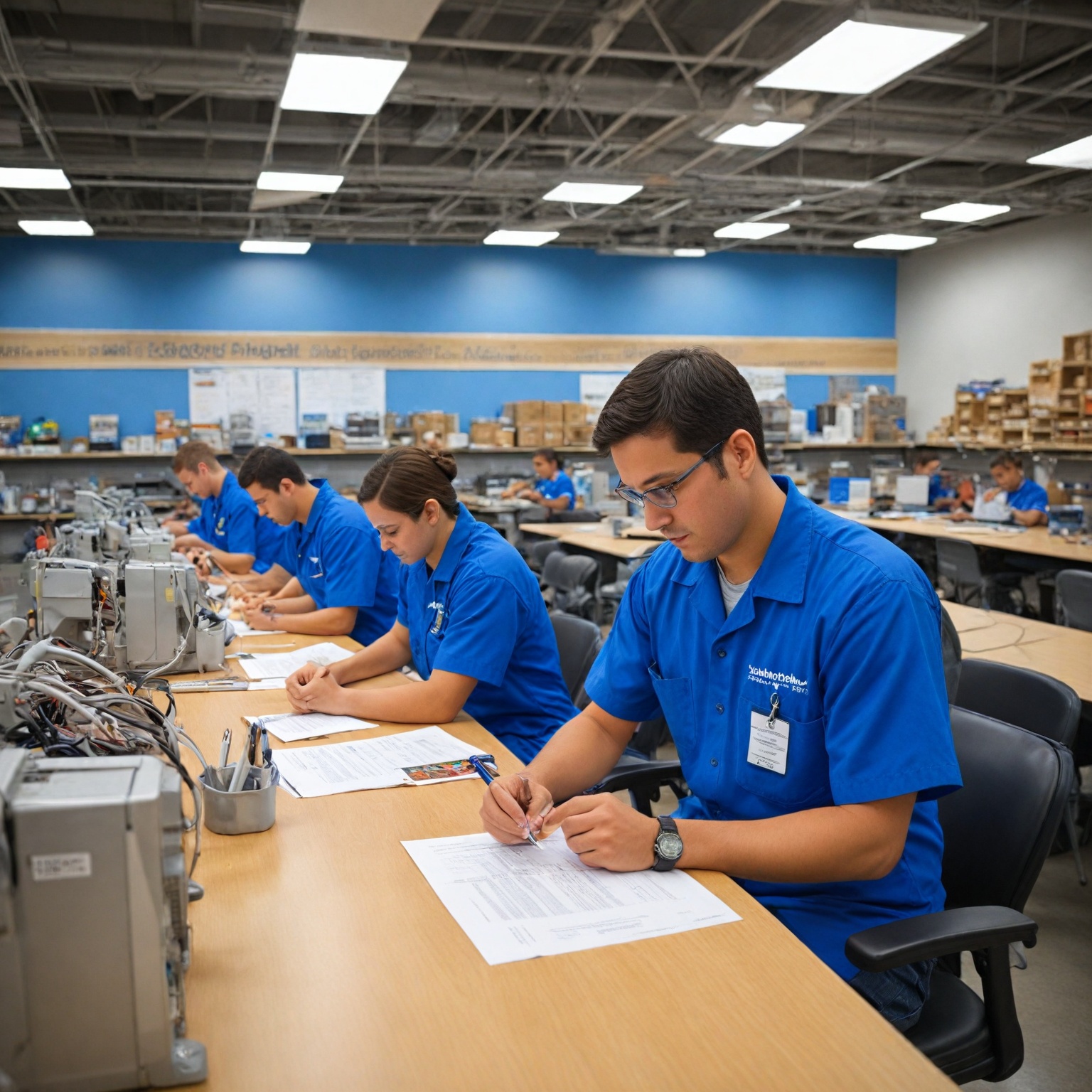
Walmart’s Associate-to-Technician (A2T) program is designed to provide frontline associates with the skills and training necessary to transition into high-demand technician roles within the company. The program blends classroom instruction with extensive hands-on training, ensuring participants develop practical, job-ready competencies in fields such as HVAC, electrical work, refrigeration, and general maintenance.
The curriculum typically consists of approximately 70 percent hands-on training combined with 30 percent classroom learning. Early in the program, associates engage in a 10-day intensive session that covers fundamental topics such as tool use, safety protocols including OSHA standards, and technical skills necessary for maintenance and repair tasks. This is followed by on-the-job training alongside experienced senior technicians, allowing participants to apply their newly acquired knowledge in real work environments.
The program is process-oriented, aligning with Walmart’s human resource objective of maintaining high performance standards through standardized procedures. This approach is particularly suited for roles involved in inventory, supply chain management, and facility services, where consistency and efficiency are critical.
Participants do not need prior maintenance or technical experience to enroll in the A2T program, only a strong interest in developing these skills, managerial approval, and dedication to the training process. The program offers an inclusive pathway to well-paying technician roles, with graduates securing jobs that pay an average of $32 per hour, ranging from $19 to $45 per hour depending on the position.
Walmart also supports its associates through educational benefits such as the Live Better U catalog, which provides access to relevant training programs tailored to individual interests and career aspirations. Student coaches assist associates in selecting appropriate programs to enhance their skills and career growth.
Through this carefully structured and comprehensive curriculum, Walmart ensures that technicians are equipped not only with the technical expertise needed to maintain equipment—from bakery ovens to refrigeration units—but also with the confidence and practical experience to contribute effectively to daily store operations.
Participant Support and Incentives
Walmart offers comprehensive support and incentives to associates participating in its technician training programs, designed to facilitate career advancement and skill development. A cornerstone of this support is the Live Better U education benefit, which pays for Walmart and Sam’s Club associates to acquire critical skills and enables them to advance into in-demand jobs within the company. This program removes common barriers to education by covering the costs of eligible programs and providing personalized guidance through student coaches who help associates select suitable courses based on their interests, schedules, and career goals.
The company emphasizes that no prior experience is necessary to participate, highlighting the accessibility of its training initiatives. Associates with an interest in hands-on work are encouraged to apply, reflecting Walmart’s commitment to fostering opportunities for a broad range of employees. The Associate-to-Technician (A2T) training program exemplifies this approach, offering a clear pathway for associates to become skilled trades professionals without requiring a college degree—only dedication, managerial approval, and a desire to grow are needed. Graduates of the program have successfully transitioned into technician roles with an average starting wage of $32 per hour, demonstrating the tangible economic incentives tied to participation.
Beyond financial support, Walmart’s training ecosystem integrates motivational elements such as increasing responsibility from day one and opportunities for rapid promotion into higher-paying, in-demand roles like store and club management, truck driving, pharmacy and HVAC technician positions. The company’s leadership underscores the transformative nature of these programs, describing them as “life-changing pathways to success” that enable associates to thrive and grow within the organization.
Walmart’s commitment to participant support also includes creating a scalable and sustainable learning environment. By quantifying the return on investment of learning and development activities, the company ensures that training initiatives remain effective and aligned with business needs. This performance-driven approach not only justifies investment but also positions training as a strategic enabler for workforce development in a challenging economic climate. Through such comprehensive support and incentives, Walmart is pioneering a model for in-house technician training that benefits both associates and the company at large.
Measurable Outcomes and Program Effectiveness
Walmart’s approach to workforce development emphasizes measurable outcomes as a key indicator of program effectiveness. By linking learning initiatives directly to tangible results, the company has built a scalable and sustainable training ecosystem that serves as a model for other organizations facing budget scrutiny and evolving workforce demands. This performance-driven strategy ensures that training investments lead to clear, high-impact outcomes, reinforcing the business value of workforce education.
The Associate to Technician (A2T) program exemplifies this focus on measurable success. The program’s six-month pilot in Dallas–Fort Worth combined 70 percent hands-on training with 30 percent classroom instruction, covering essential skills such as OSHA safety, electrical fundamentals, HVAC, refrigeration, and troubleshooting. Impressively, every graduate of this pilot secured a technician role, with wages averaging $32 per hour and ranging from $19 to $45 per hour. This outcome not only highlights the program’s effectiveness in preparing associates for skilled roles but also demonstrates its impact on upward mobility within the company.
Furthermore, Walmart is expanding the A2T program to additional locations including Vincennes, Indiana, and Jacksonville, Florida, with a target of training 4,000 associates by 2030. This expansion is driven by the positive outcomes seen in the pilot, as well as by the company’s broader goal of creating a robust talent pipeline that supports faster hiring, consistent staffing, and reliable operational performance across stores, clubs, and supply chain facilities. The ability of trained technicians to maintain equipment—from bakery ovens to refrigerated produce cases—ensures continuous service quality that customers depend on every day.
Beyond technician training, Walmart’s use of technology and data to measure learning effectiveness underpins its ability to adapt and future-proof its workforce development programs. By systematically evaluating how learning translates into performance improvements, the company can optimize program design and scale initiatives with confidence, thereby maximizing return on investment.
Partnerships and Collaborations
Walmart has established strategic partnerships to develop and expand its Associate to Technician (A2T) program, aiming to address the skilled labor shortage by training its own frontline employees for technician roles. A key collaboration is with Vincennes University (VU), which supports Walmart in providing hands-on technician training to associates. This partnership marks the expansion of the A2T program to Vincennes, Indiana, following the success of a pilot program in the Dallas-Fort Worth area. All 108 graduates from the pilot secured technician positions with an average earning potential of $32 per hour, highlighting the program’s effectiveness in creating well-paying career pathways.
VU Vice President for Workforce Development and Community Services, David Tucker, emphasized that the collaboration aligns with the university’s commitment to workforce-driven education tailored to current employer needs. He described the program as “more than training” but a “life-changing pathway to success” for Walmart associates, underscoring the university’s role in preparing individuals for meaningful careers that address workforce demands.
Beyond Vincennes University, Walmart has expanded the A2T program to other locations such as Jacksonville, Florida, further broadening access to technical education in critical fields including heating, ventilation, air conditioning (HVAC), electrical work, and general maintenance. This initiative combines classroom learning with hands-on instruction to equip associates with the necessary skills to succeed in these in-demand trades.
These partnerships reflect Walmart’s broader strategy to create internal career pathways by removing traditional college degree requirements where possible and focusing on skill development. The company positions the A2T program as part of the largest private training effort in the nation, aimed at solving the talent shortage by developing the next generation of skilled trades professionals from within its workforce.
Comparative Analysis
Walmart’s approach to addressing the skilled labor gap through its in-house technician training program demonstrates a strategic integration of workforce development with business objectives. Unlike traditional training programs that often function primarily as human resource initiatives, Walmart’s model emphasizes measuring learning return on investment (ROI) to refine strategies and justify learning and development (L&D) expenditures. This performance-driven methodology positions training as a key business enabler rather than merely an administrative function, a stance that other organizations facing budget scrutiny might find instructive.
The program’s structure is tailored to meet diverse job requirements across Walmart’s organizational hierarchy. For example, productivity standards are prioritized for warehouse employees, decision-making and financial metrics guide managerial roles, and salesmanship skills are emphasized for frontline sales staff. This differentiation ensures that training outcomes align with specific job functions and business needs, fostering more effective workforce performance.
A hallmark of Walmart’s initiative is the Associate-to-Technician (A2T) program, which exemplifies the company’s commitment to internal career advancement and skills development without requiring a formal degree. The A2T program combines extensive hands-on training (70%) with classroom instruction (30%), covering critical areas such as OSHA safety standards, electrical fundamentals, HVAC, refrigeration, and troubleshooting. Graduates of the pilot program in Dallas–Fort Worth have all secured technician roles, earning an average wage of $32 per hour, with salaries ranging from $19 to $45 per hour.
Moreover, Walmart’s expansion plans for the A2T program—including new sites in Vincennes, Indiana, and Jacksonville, Florida—aim to scale the initiative significantly, targeting 4,000 associates by 2030. This broadening scope reinforces the program’s role as a replicable model for other businesses seeking to build a skilled trades workforce internally, rather than relying solely on external hiring or degree-dependent recruitment.
Challenges and Limitations
Walmart’s in-house technician training programs, while innovative and impactful, face several challenges and limitations. One significant issue arises from the reliance on standardized processes, which demands rigorous adherence to established procedures to maintain operational efficiency. Any inaccuracies in recording or reporting during training can cascade into larger problems such as the bullwhip effect, disrupting inventory management and supply chain operations. This highlights the necessity of error minimization through effective training, yet also underscores the risk of productivity losses if training is not consistently precise.
Another challenge is the critical nature of maintenance roles, particularly during peak periods like the holiday season. Failures such as refrigeration breakdowns can cause substantial financial losses—up to $400,000 per incident in spoiled goods. This places considerable pressure on training programs to equip associates with preventative maintenance skills and rapid repair capabilities. However, the need to develop these skills from diverse associate backgrounds, many without prior maintenance experience, requires ongoing investment and tailored program design.
Expanding programs like the Associate-to-Technician (A2T) initiative to new locations in Indiana and Florida aims to address workforce shortages and create career advancement opportunities, but scaling these efforts presents logistical and resource allocation challenges[8
Future Prospects and Strategic Goals
Walmart’s strategic vision centers on expanding its Associate to Technician (A2T) program to address the skilled labor shortage by training 4,000 technicians by 2030. This ambitious goal aims to develop a robust in-house workforce capable of maintaining the company’s extensive infrastructure, including refrigeration, electrical systems, and other essential store and distribution center operations. The program’s success is underscored by its initial pilot in Dallas–Fort Worth, where all 108 graduates secured technician roles earning an average of $32 per hour, with wages ranging from $19 to $45.
In addition to expanding geographic reach by introducing two new training locations in Vincennes, Indiana, and Jacksonville, Florida, Walmart is enhancing candidate support with innovative tools such as an AI Interview Coach. This tool helps applicants, both internal and external, prepare for Walmart roles by simulating realistic interviews, providing scored feedback, and offering pointers on communication and confidence. Such technological integration aligns with Walmart’s commitment to helping associates build sustainable careers.
Walmart’s approach removes traditional barriers by eliminating college degree requirements for many technician and frontline roles, focusing instead on dedication, managerial approval, and a desire to grow. The program combines 70% hands-on training with 30% classroom instruction on critical subjects like OSHA safety, electrical fundamentals, HVAC, refrigeration, and troubleshooting. This comprehensive training model not only equips associates with technical skills but also fosters decision-making and results orientation, key attributes emphasized particularly for managerial and supervisory positions.
Case Studies and Success Stories
Walmart’s Associate-to-Technician (A2T) program serves as a prominent example of successfully addressing the skilled labor gap through in-house training. The program combines 70 percent hands-on training with 30 percent classroom instruction, covering critical areas such as OSHA safety, electrical fundamentals, HVAC, refrigeration, and troubleshooting. Since the pilot program in Dallas–Fort Worth, 108 associates completed the six-month training, with every graduate securing a technician role and earning an average wage of $32 per hour, ranging from $19 to $45 per hour.
Building on this success, Walmart is expanding A2T to additional locations, including Vincennes, Indiana, and Jacksonville, Florida, aiming to train 4,000 associates by 2030. The program requires no degree but emphasizes dedication, managerial approval, and a desire to grow. From the outset, participants take on increasing responsibilities and develop skills that translate into higher-paying roles and greater impact within the company.
Individual success stories highlight the transformative potential of the program. For example, an associate who began in a general maintenance role in central Florida was quickly recognized for his potential and encouraged by his manager and people lead to pursue career growth opportunities through the A2T program. Such personal narratives underscore the program’s role not only as training but as a life-changing pathway to success for Walmart associates.
Furthermore, the program is supported by personalized coaching, where student coaches assist associates in selecting the right training path aligned with their interests and career aspirations. This comprehensive support system reflects Walmart’s broader commitment to preparing individuals for sustainable careers and addressing workforce needs through innovative, scalable solutions.
The content is provided by Avery Redwood, 11 Minute Read


