
Summary
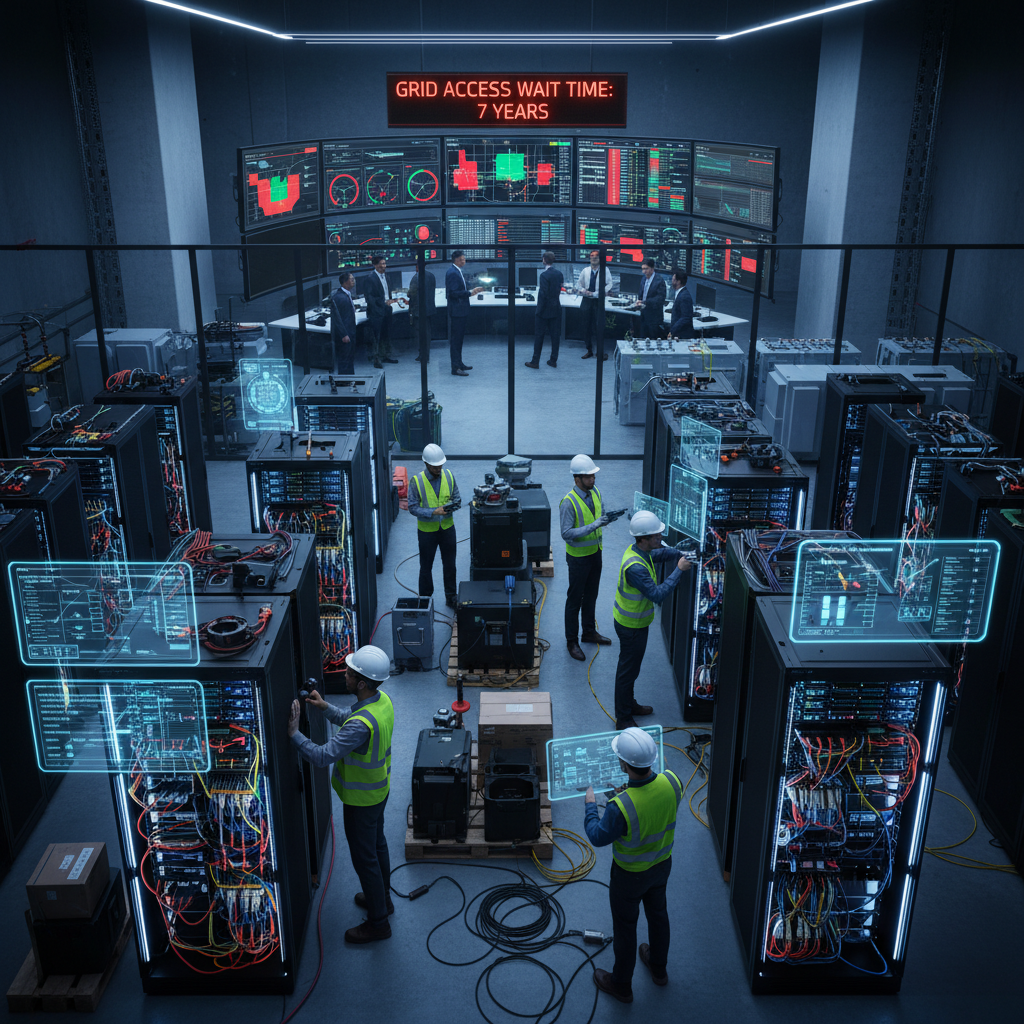
The rapid growth of data center development in the United States has led to unprecedented challenges in securing timely access to the electrical grid, with wait times for grid interconnection sometimes extending up to seven years. Data centers, which underpin critical digital infrastructure including cloud computing and artificial intelligence, demand exceptionally reliable and high-capacity power connections. This surge in demand, driven by the expansion of hyperscale and AI-focused facilities, has strained existing transmission and generation infrastructure beyond traditional planning assumptions, creating significant bottlenecks in the grid interconnection process.
Extended delays result from a combination of technical, regulatory, and supply chain factors. Utilities face limited spare transmission capacity, lengthy lead times for infrastructure upgrades, and stringent reliability standards that emphasize worst-case scenarios such as peak demand and equipment outages. These challenges are compounded by regulatory frameworks that often require data center developers to assume full financial responsibility for network upgrades, along with local permitting hurdles and community opposition, which can further prolong project timelines. Supply chain constraints for critical electrical equipment have also contributed to the backlog, despite recent improvements.
In response, federal and state agencies have introduced reforms aimed at streamlining interconnection procedures and accelerating grid access. The Federal Energy Regulatory Commission’s (FERC) Order No. 2023, issued in 2023, mandates cluster study processes to improve efficiency and enforce stricter deadlines on transmission providers, while state policies increasingly shift upgrade costs to large power users. Utilities and developers are also adopting innovative approaches such as hybrid power strategies combining grid power with on-site generation and battery storage to mitigate grid congestion and enhance reliability.
Despite these efforts, the sector continues to grapple with balancing rapid data center growth and grid reliability, highlighting ongoing tensions among developers, utilities, regulators, and communities. The prolonged wait times not only threaten data center expansion plans but also raise broader concerns about infrastructure investment, energy affordability, and the equitable allocation of costs across electricity consumers. As data center power demand is projected to increase substantially over the next decade, the urgency for comprehensive policy, technological, and operational solutions remains a critical challenge for the U.S. electric grid.
Background
The rapid expansion of data center development across the United States has created significant challenges related to securing timely and reliable access to electrical grid power. Data centers, which are critical infrastructure supporting cloud computing, artificial intelligence, and digital services, require extremely high levels of power reliability, often committing to service availability of 99.995% or higher. To achieve this, many operators are adopting hybrid power strategies that combine grid power with on-site generation or battery storage, allowing continuous operation even when the grid is stressed or undergoing maintenance.
Despite this innovative approach, the demand for grid connections from data center developers has surged dramatically in recent years. Utilities across the country are experiencing unprecedented growth requests, often surpassing the typical annual load growth seen over a decade within a single year. This rapid escalation is partly driven by the growing needs of AI data centers, with forecasts estimating a 3.5-fold increase in demand from 2025 to 2030, reaching 156 gigawatts worldwide, with the United States as the fastest growing market.
However, utility companies and grid operators face challenges in accommodating these new large loads. Current regulatory frameworks and operational policies, such as those outlined in regional “green books,” require thorough reliability assessments focusing on worst-case scenarios, including peak system demand and contingency events like transmission line or generator outages. These conservative evaluations often result in delays or denials of interconnection requests, as grid planners prioritize system stability and risk mitigation.
The complexity is further compounded by supply chain constraints that affect the procurement and installation of necessary electrical equipment. Although supply chain disruptions have eased compared to the early 2020s, delays in obtaining components remain an obstacle, contributing to extended wait times for grid access. Utilities frequently schedule new connections years in the future, anticipating the availability of additional generation capacity and equipment to support the increased load.
These grid access delays, sometimes extending up to seven years, have become a significant source of frustration for data center developers. The challenges are not only technical but also social, as communities affected by new data center projects often report being uninformed or excluded from early planning processes, leading to local opposition and regulatory hurdles that can further slow project timelines. The distribution of data centers generally aligns with major metropolitan regions across the East, Central, and West areas of the United States, where low-latency connections to key markets are essential.
In response, some utilities and regional grid operators are exploring innovative measures to better manage the electricity demand from data centers and to streamline interconnection processes, aiming to balance rapid growth with grid reliability. Nonetheless, the scale and speed of data center expansion continue to test the limits of existing grid infrastructure and regulatory policies.
Causes of Extended Wait Times for Grid Access
Extended wait times for grid access faced by data center developers in the United States are driven by a combination of technical, regulatory, and supply chain challenges. One significant factor is the persistent difficulty in acquiring the physical electrical equipment necessary for establishing grid connections. Although acute supply chain delays from the early 2020s have lessened, electrical components such as transformers and cables remain scarce, causing utilities to delay grid connections while awaiting these critical materials.
Long lead times for the development of new generation capacity, transmission lines, and substations further exacerbate these delays. Infrastructure projects required to support new large loads, including data centers, often span several years in planning and construction. This slow pace conflicts with the rapid development timeline typical of data centers. Regulatory bodies have begun imposing new interconnection terms, such as minimum billing and collateral requirements, to protect existing ratepayers from the costs of infrastructure expansion. These measures add complexity and financial burdens to the grid connection process.
Grid congestion and insufficient transmission capacity are central technical constraints. Many power systems lack the spare transmission and generation capacity to reliably accommodate dozens of gigawatts of new, high-utilization demand at all times, especially under worst-case conditions such as peak system demand or the loss of major equipment (N-1 or N-2 contingencies). Grid planners adhere to strict reliability criteria outlined in so-called “green books,” which focus on these worst-case scenarios. Consequently, many otherwise viable projects are flagged as too risky and deferred until additional infrastructure or generation capacity becomes available.
Moreover, utilities are increasingly requiring data centers to include on-site generation, battery energy storage systems, or grid-interactive substations as part of their connection plans to mitigate these risks and reduce dependency on strained grid infrastructure. Environmental permitting and decarbonization policies have also made it more difficult and time-consuming to add traditional generation and transmission capacity quickly, contributing to extended backlogs and increased costs.
At the regulatory level, local opposition and permitting delays pose additional hurdles. Since most permitting decisions occur at the local level, community resistance—often driven by nonpartisan NIMBY (Not In My Backyard) concerns—can slow or block data center developments despite supportive federal policies.
In response to these systemic challenges, the Federal Energy Regulatory Commission (FERC) issued Order No. 2023 in July 2023, aiming to reform interconnection procedures and reduce project backlogs. However, the backlog remains substantial, with some regions experiencing seven-year or longer wait times for grid access.
Detailed Grid Interconnection Process
The grid interconnection process for large data center projects in the United States is complex and often prolonged, contributing to wait times that can extend up to seven years or more. This process involves multiple stages including planning, permitting, procurement, and construction of necessary transmission and generation upgrades. These stages are essential because the current power system frequently lacks the surplus capacity needed to accommodate new, high-utilization loads 100% of the time, leading to significant delays.
Grid planners evaluate interconnection requests based on stringent criteria outlined in regulatory “green books,” which emphasize worst-case scenarios such as peak system demand and contingency events like the loss of transmission lines or generators. This conservative approach, while aimed at ensuring reliability, often results in delays or denials for many large load connections, as utilities prioritize risk mitigation and system stability.
To handle the increasing influx of large load requests—often in the tens of gigawatts range—regional transmission organizations (RTOs) and independent system operators (ISOs) have begun adopting reforms, including cluster study processes mandated by FERC’s Order No. 2023. This order requires grouping interconnection requests for collective study, which improves efficiency and reduces speculative applications lacking financial backing. These reforms also introduce a customer engagement window, allowing transmission providers to meet with interconnection customers to discuss study costs and application deficiencies before proceeding.
Specific regional practices illustrate the evolving interconnection landscape. For instance, PJM has integrated data center clusters into its load forecasting and interconnection processes. Developers in PJM must provide detailed ramping schedules, operational characteristics, and phased expansion plans to ensure grid reliability and facilitate accurate capacity forecasting.
Despite procedural improvements, the interconnection process remains a bottleneck. Utilities like ComEd, PPL, and Oncor report data center applications exceeding their historical peak demands, stressing the grid’s capacity and leading to lengthy queue backlogs. Moreover, the lack of sufficient transmission capacity and generation resources has led to speculative requests that further clog the system, necessitating modernization of planning tools and clearer definitions of interconnection procedures to accelerate application reviews.
Financial responsibilities for network upgrades are also a critical aspect of the process. Under proposed reforms, large load and hybrid facilities may be held accountable for 100% of network upgrade costs assigned through interconnection studies. When the interconnection customer does not own the transmission infrastructure, they retain rights similar to generators in funding these upgrades directly, rather than relying on the electric utility.
In sum, the detailed grid interconnection process involves navigating a highly regulated and risk-averse system designed for smaller-scale projects that is now contending with surging, complex demands from large data center developments. The combination of stringent evaluation criteria, capacity constraints, lengthy upgrade timelines, and financial cost allocations contributes to the frustratingly long wait times for grid access experienced by data center developers.
Regional Variations in Wait Times
Wait times for grid interconnection requests vary significantly across different U.S. regions, reflecting diverse challenges in transmission infrastructure, regulatory environments, and market conditions. Generally, interconnection queues have experienced unprecedented backlogs nationwide, with typical wait times extending beyond three years for completing grid impact studies in most areas. However, some regions exhibit notably faster processing speeds; for instance, ERCOT in Texas is recognized for handling requests more quickly compared to other markets.
Northern Virginia, home to over 300 data centers that contribute approximately $9.1 billion annually to the state economy, exemplifies extreme delays, with developers facing wait times of up to seven years for grid connections. This prolonged timeline threatens the region’s ability to sustain its position as a leading data center hub amid surging demand. PJM Interconnection, the regional grid operator serving much of the Mid-Atlantic and Midwest, projects demand growth well beyond historical trends, further straining existing infrastructure. As a result, local lawmakers are exploring stricter siting regulations and cost-sharing mechanisms to manage grid upgrade expenses associated with large new loads.
The Midwest also confronts growing congestion and long-lead transmission needs, driven by hyperscale data center expansions into states once known for abundant, low-cost power. The Midcontinent Independent System Operator (MISO), overseeing electricity markets across 15 states, identifies factors such as a shortage of software vendors as key barriers contributing to interconnection delays. Similar to other regions, Midwestern utilities increasingly require developers to assume greater responsibility for infrastructure enhancements, including on-site generation and battery energy storage, to mitigate extended timelines and grid constraints.
Ohio and Virginia illustrate regulatory responses to these challenges by implementing new interconnection terms that impose minimum billing and collateral provisions on data centers to protect other ratepayers from infrastructure costs. Moreover, West Virginia has enacted legislation establishing “certified microgrid districts,” enabling data centers to pair with dedicated generation sources while shielding broader utility customers from cost burdens. These measures reflect a broader trend where grid access is no longer unconditional; large energy users are increasingly expected to contribute to the buildout and financing of the infrastructure they depend on.
Collectively, these regional variations underscore the complexity of integrating large-scale data center developments into existing grid systems, highlighting the need for tailored regulatory frameworks and accelerated transmission expansions to address the growing demand and reduce wait times across the country.
Impact of Prolonged Wait Times
Prolonged wait times for grid interconnection have significant consequences for data center developers, particularly those managing large-scale facilities. The backlog in interconnection queues and the increasing duration of grid impact studies—now often exceeding three years in many regions—create substantial delays in securing the necessary power connections to support data center operations. For example, in Virginia, wait times for grid connections can extend up to seven years, posing a critical challenge to the near-term deployment of new data centers.
These delays stem from a combination of factors, including outdated and overburdened electrical grids, the surge in demand from data centers, and utility companies’ cautious approach to approving connections while awaiting upgrades or equipment. Regions with dense concentrations of data centers, such as Northern Virginia, experience particularly acute constraints on power availability, further exacerbating connection delays. The growing load from rapid data center expansion strains transmission infrastructure, creating risks during peak demand periods and complicating the process of integrating new large loads into the grid.
The extended wait times impact not only project timelines but also the strategic decisions of data center developers. Utilities typically evaluate interconnection requests using risk-focused criteria that consider worst-case scenarios, including peak system demand and contingency events, which can result in delays or denials for large load connections. Consequently, many developers face uncertainty and increased costs as they navigate these regulatory and operational hurdles.
Beyond operational impacts, the grid connection backlog has broader implications for energy planning and infrastructure development. Meeting data center power demands under constrained conditions may necessitate increased investment in battery storage, natural gas peaker plants, and other flexible resources to maintain reliability. Innovative approaches such as energy park models and co-located generation or storage offer potential solutions to unlock higher capacity interconnections even in seemingly constrained systems.
Moreover, regulatory proposals are emerging to address cost allocation challenges associated with grid upgrades. For instance, the Federal Energy Regulatory Commission (FERC) has suggested that large load and hybrid facilities bear full responsibility for network upgrade costs assigned through interconnection studies, potentially accelerating investment in necessary infrastructure. Despite these efforts, the rapid pace of data center growth continues to outstrip existing transmission policies and infrastructure capabilities, underscoring the urgent need for reforms to reduce wait times and enable more efficient grid integration of data centers.
Regulatory and Policy Reforms Addressing Wait Times
The prolonged wait times for grid access faced by data center developers have prompted significant regulatory and policy interventions aimed at accelerating interconnection processes and improving grid integration efficiency. In response to increasing delays—often extending up to seven years—regulators and policymakers at both federal and state levels have initiated reforms designed to streamline transmission interconnection and address bottlenecks caused by queue backlogs, study delays, and evolving infrastructure needs.
A landmark federal initiative is the Federal Energy Regulatory Commission’s (FERC) Order No. 2023, issued on July 28, 2023, which seeks to modernize generator interconnection procedures. This order introduced a cluster study process, whereby transmission providers evaluate multiple interconnection requests collectively rather than sequentially, aiming to reduce overall study times and improve cost predictability. The order also eliminated the “reasonable efforts” standard, imposing stricter deadlines for transmission providers to complete cluster studies, restudies, facilities studies, and affected system studies to promote timelier project evaluations. These affected system studies, which assess interconnection impacts on neighboring grids, now adhere to enhanced transparency and uniform modeling standards, helping to mitigate cost uncertainties and delays associated with this additional review layer.
On March 21, 2024, FERC issued Order No. 2023-A, a follow-up ruling that upheld most reforms from the initial order while clarifying procedural aspects and reaffirming penalties for transmission providers who miss study deadlines. The order recognized the need for regional flexibility, allowing case-by-case deviations when justified, but maintained strong pressure on transmission operators and the Commission to implement reforms rapidly[10
Industry and Utility Responses
The rapid growth of data center demand in the United States has placed unprecedented strain on utilities and grid operators, prompting a range of responses from both industry stakeholders and regulatory bodies. Utilities are grappling with how to accommodate large, fast-moving load requests amid limited transmission capacity and generation resources, often resulting in extended wait times for interconnection approvals. In response, several utilities and regulators have adopted or are considering new policies and strategies to manage these challenges.
One key industry response involves the encouragement of “bring your own power” (BYOP) models, where data center developers provide on-site generation or storage resources to reduce net grid demand. This approach is gaining traction as a way to ease interconnection queues and improve system reliability by lessening the burden on the existing grid infrastructure. However, BYOP strategies come with regulatory and legal challenges, such as potential disruption to established grid planning processes and complexities in interconnection agreements. Utilities have expressed concerns that without careful management, BYOP could negatively impact overall system reliability.
Utilities are also modernizing their interconnection procedures and planning models to better handle the surge in large load requests. For example, Arizona utilities like Salt River Project (SRP) and Arizona Public Service (APS) are expanding gas peaker plants combined with battery storage and employing stricter queue management and prioritization policies to support reliability while advancing decarbonization goals. In the Midwest, regulatory bodies such as the Indiana Utility Regulatory Commission (IURC) have introduced new large-load interconnection rules, and utilities like Indiana Michigan Power (I&M) have entered into demand-response agreements with major data center operators to mitigate peak load impacts.
Efforts to alleviate the interconnection backlog also emphasize collaboration among utilities, developers, and regulators. Utilities are encouraged to streamline approval processes and update policy frameworks, developers are urged to engage earlier and consider flexible or hybrid power solutions, and regulators are tasked with balancing innovation incentives against the imperative to maintain grid reliability. Transparent communication between developers and utilities, including sharing accurate forecasts and realistic commissioning schedules, has been identified as a means to build trust and reduce review times.
Some developers have found that self-supply options, such as on-site power generation, can be faster to implement than procuring traditional grid power because they avoid certain regulatory delays associated with utility-owned generation. Nonetheless, on-site generation projects may require federal authorizations from agencies like the Federal Energy Regulatory Commission (FERC), the Nuclear Regulatory Commission (NRC), or the U.S. Army Corps of Engineers, adding another layer of regulatory complexity.
Environmental permitting and decarbonization mandates are further shaping industry responses. Federal and state policies have made it increasingly difficult to quickly add traditional generation capacity, and lengthy environmental reviews delay large transmission projects. As a result, power infrastructure planning is evolving from a late-stage utility consideration to an early driver of data center design, as evidenced by projects such as Chevron’s planned dedicated power-generation facility in West Texas aimed at supporting data center demand.
Case Studies
One notable example of delays impacting data center developers is the experience in Virginia, where connection times to the electrical grid can extend up to seven years. This protracted timeline poses significant challenges for large-scale data centers seeking near-term grid access to power their operations. The delays stem from a combination of factors, including extended regulatory reviews, permitting hurdles, and legal challenges, which disrupt the original development schedules but do not necessarily halt progress entirely.
The Midcontinent Independent System Operator (MISO), which oversees electricity markets across 15 states, has highlighted a shortage of software vendors as a key barrier contributing to interconnection delays. This bottleneck further exacerbates the long wait times data center developers face when trying to secure reliable grid connections.
Large data centers requiring more than 100 megawatts of electricity are particularly affected by these extended wait times. However, projects that have already undergone evaluation are generally not subject to the longer delays. This distinction was communicated in a letter from a transmission company’s regulated utility division to co-ops and local utilities, emphasizing the specific impact on new, large-scale projects.
In response to these challenges, Federal Energy Regulatory Commission (FERC) Order No. 2023 introduced reforms aimed at improving the consistency of the interconnection process. However, the order has faced criticism for ambiguities, especially concerning the cure period for correcting deficient applications and how it overlaps with the customer engagement window. This engagement phase allows transmission providers to discuss study costs and other issues with interconnection customers before proceeding further. Some commenters argued that the lack of clarity in the order may contribute to continued delays and inefficiencies in the interconnection process.
These delays in grid access have broader implications beyond individual projects. The U.S. data center market is projected to grow substantially, with anticipated demand increasing by at least 65 gigawatts and potentially up to 90 gigawatts by 2029. Without improvements in the interconnection process and grid infrastructure, the risk of prolonged wait times could hinder the sector’s growth and the broader economy’s digital infrastructure development.
Future Outlook
The future outlook for data center grid access in the United States is shaped by a complex interplay of rapidly increasing demand, regulatory challenges, and infrastructure constraints. The country’s data center market is projected to grow significantly, with expected capacity additions between 65GW and 90GW by 2029, underscoring the urgency of addressing grid limitations. However, widespread delays in transmission interconnection and upgrades pose substantial risks to this growth trajectory, with some projects facing wait times as long as seven years or more, threatening to stall the sector’s expansion.
A key factor complicating timely grid access is the existing regulatory framework, which struggles to keep pace with the rapid development of large data centers and their immense power requirements. Current policies often place a substantial cost burden on interconnection customers, including data center operators, who may be responsible for 100% of network upgrade costs. This situation is exacerbated when interconnection customers are not also transmission owners, limiting their influence over upgrade timelines and funding mechanisms. Federal and state environmental permitting processes further contribute to delays, as lengthy reviews slow the addition of traditional generation and large transmission projects necessary to meet data center energy demands.
Efforts to modernize grid management, such as upgrading static transmission settings to incorporate real-time environmental factors like temperature and wind, are underway but not expected to be completed until mid-2025. These upgrades aim to optimize transmission capacity and could alleviate some bottlenecks once implemented. Meanwhile, advanced load forecasting and the adoption of distributed energy solutions, including onsite generation and energy storage, are gaining attention as critical strategies to enhance grid reliability and reduce dependency on central infrastructure expansion. By managing demand more flexibly, these approaches can help mitigate some challenges associated with prolonged interconnection wait times.
The escalating demand driven by artificial intelligence workloads and hyperscale data center expansion continues to place upward pressure on transmission infrastructure investment. This surge has led to increased residential power prices in key data center markets, raising concerns about affordability and the equitable distribution of grid upgrade costs. While many power companies remain optimistic that residential affordability issues will not impede data center development, less than half of data center operators share this confidence, highlighting ongoing tensions in cost allocation and regulatory policy.
Looking ahead, the regulatory landscape may evolve as the Federal Energy Regulatory Commission (FERC) considers expanded jurisdiction to expedite grid access for large industrial customers, potentially enabling faster and more coordinated transmission planning and cost allocation. However, the complexity of integrating large, flexible loads with environmental and community considerations suggests that achieving a timely and sustainable expansion of grid capacity will require continued innovation in both technology and policy.
The content is provided by Harper Eastwood, 11 Minute Read