Summary
Unlocking Success: How the AI Data Center Surge Supercharged Caterpillar’s Power and Energy Division and Skyrocketed Generator Sales examines the transformative impact of artificial intelligence (AI) on Caterpillar Inc.’s power and energy business. The unprecedented growth in AI workloads has driven massive expansion in data center infrastructure, resulting in a surge in demand for reliable, scalable, and efficient power generation and cooling solutions. Caterpillar, historically known for heavy machinery, has strategically repositioned its Energy & Power Systems division to capitalize on this demand, making power generation a critical and fast-growing segment of its revenue—accounting for nearly 40% in some analyses. This pivot has involved significant investments, including a $725 million expansion of its Lafayette, Indiana facility, aimed at more than doubling turbine production capacity by 2030.
The surge in AI data centers poses unique challenges and opportunities for energy infrastructure. Data centers’ soaring electricity consumption—projected to account for up to 21% of global energy use by 2030 due to AI workloads—necessitates robust on-site power generation to complement or bypass congested utility grids. Caterpillar’s portfolio, spanning quick-start diesel generators to hybrid systems integrating natural gas, hydrogen fuel cells, and battery storage, addresses these needs while aligning with increasing sustainability goals. Partnerships with technology leaders such as Vertiv and project collaborations like the high-capacity data center campus in Utah underscore Caterpillar’s role in delivering integrated, modular power and cooling solutions tailored for AI-driven infrastructure.
Despite these advances, Caterpillar’s expansion is not without risks. The company faces challenges from fluctuating demand, trade tariffs, and a potentially slowing construction sector, alongside broader energy market uncertainties. Moreover, the evolving energy landscape—including cybersecurity threats linked to AI integration and the critical mineral supply chain constraints—adds complexity to sustaining growth. How Caterpillar navigates these issues, while continuing to innovate with hybrid and low-emission power technologies, will be crucial to maintaining its market position in the rapidly evolving AI data center ecosystem.
This article provides a comprehensive overview of Caterpillar’s strategic transformation driven by the AI data center surge, detailing its product innovations, partnerships, financial impact, and future outlook. It highlights the company’s significant economic contributions and environmental initiatives, illustrating how Caterpillar has become a pivotal player in powering the next generation of digital infrastructure amid the AI revolution.
Background
The rapid expansion of artificial intelligence (AI) technologies has significantly increased the demand for data centers, which serve as the backbone for AI development and deployment. This surge has led to a corresponding rise in the need for robust and scalable power and cooling infrastructure to support the energy-intensive operations of modern data centers, particularly those used for AI training and inference. Generative AI models require dense computational power, resulting in enormous electricity consumption, which in turn has transformed the power systems segment into a vital and growing portion of companies like Caterpillar’s revenue stream—reportedly accounting for nearly 40% of the company’s total revenue in some analyses.
Caterpillar, historically recognized for its construction equipment such as bulldozers and dump trucks, has increasingly positioned itself as a key player in power generation solutions tailored for the burgeoning AI data center market. The company’s Energy & Power Systems division is responding to the surge in generator demand driven by AI data centers with significant investments. These include a $725 million expansion of its Lafayette, Indiana facility and plans to more than double turbine-engine production by 2030. This strategic pivot highlights Caterpillar’s commitment to meeting the specialized power needs of data centers that require not only grid connectivity but also reliable on-site power generation to maintain uptime and performance.
Environmental control and cooling are critical components of data center operations, as maintaining optimal temperature and humidity levels is essential for the reliability of IT equipment. Cooling systems can represent a substantial share of data center energy consumption, varying from about 7% in efficient hyperscale data centers to over 30% in less-efficient enterprise facilities. In regions like the Middle East, where sustainability is becoming a higher priority, Caterpillar’s focus on flexible, reliable power solutions incorporating renewable energy sources aligns well with regional goals. The company supports financial stability through power purchase agreements (PPAs) and innovative rental solutions, facilitating the growth of the data center industry in such emerging markets.
Despite the optimistic outlook, Caterpillar’s expansion in power generation capacity is not without risks. Fluctuations in demand, trade tariffs, interest rates, and a slower construction environment pose challenges typical of the heavy industry sector. Nonetheless, the company’s management remains deeply convinced of the long-term potential of the AI-driven data center market and continues to invest heavily to capitalize on these emerging opportunities.
Moreover, the growing integration of AI within energy utilities brings both security challenges and solutions. Cyberattacks on energy infrastructure have increased significantly, with AI playing a dual role in both enabling more sophisticated attacks and providing critical tools for defense. Additionally, the rising demand for critical minerals required in the manufacture of data center equipment poses another layer of complexity to sustaining the AI data center ecosystem. Together, these factors underscore the multifaceted landscape in which Caterpillar’s power and energy division operates amid the AI data center surge.
The AI Data Center Surge and Its Energy Implications
The rapid expansion of artificial intelligence (AI) technologies has led to a significant increase in demand for data center infrastructure, particularly in terms of power and cooling requirements. AI training clusters are highly energy-intensive, necessitating reliable and scalable power solutions to support their operations. This growing need has prompted collaborations, such as that between Vertiv and Caterpillar, aiming to address these infrastructure challenges effectively.
Data centers currently account for approximately 1% to 2% of global energy consumption, a figure comparable to the airline industry’s demand. However, this share is expected to rise dramatically due to escalating AI-related activities, with projections suggesting data centers could consume up to 21% of global energy by 2030 when considering AI delivery costs. Cooling requirements further exacerbate sustainability concerns, as more equipment is packed into increasingly dense physical spaces, demanding advanced cooling technologies that often draw heavily from already stressed water resources.
In advanced economies, data centers are anticipated to drive over 20% of electricity demand growth by 2030, reversing previous trends of stagnation or decline in power usage. Renewable energy sources and natural gas are poised to lead this expansion due to their cost-effectiveness and availability in key markets. The United States exemplifies this trend, where data center power consumption is projected to account for nearly half of the country’s electricity demand growth by 2030. Notably, the electricity consumed by data processing in the U.S. is expected to surpass that used in manufacturing all energy-intensive products combined, including aluminium, steel, cement, and chemicals.
The fulfillment of AI’s potential hinges on substantial investments in both data center capacity and power infrastructure. The surging adoption of AI and digitalization across the United States is amplifying demand for data centers, creating emerging opportunities for investors in power generation and related sectors. Caterpillar’s energy portfolio exemplifies this multi-faceted approach, offering a range of solutions from quick-start diesel generators to energy storage, natural gas, and hydrogen-fueled generation aimed at reducing emissions. Many customers are now opting for blended energy solutions to meet their evolving needs.
Caterpillar anticipates a 25% increase in U.S. electricity demand between 2023 and 2035—rising to 60% by 2050—with global demand increasing correspondingly. This growth is partly driven by AI-related data center expansion and the electrification of oil and gas production. Data centers require not only primary power generation but also uninterruptible power supply (UPS) batteries and backup generators to maintain extremely high reliability standards during outages, despite these systems being rarely activated.
An illustrative example of this surge is Joule Capital Partners’ ambitious data center project in Utah, which is expected to consume 1.5 gigawatts of electricity by 2028—about a quarter of the state’s current power usage. To meet this demand, the project has ordered over 700 natural-gas generators from Caterpillar, highlighting the scale and urgency of energy infrastructure expansion driven by AI data centers.
Caterpillar’s Power and Energy Division: Profile and Capabilities
Caterpillar’s Power and Energy division has evolved from a relatively modest component of the company into a vital and rapidly growing segment, driven largely by the surging demand for reliable power in artificial intelligence (AI) data centers and other digital infrastructure. Traditionally known for its construction and mining equipment, Caterpillar has expanded its footprint through its Energy & Transportation division, which manufactures diesel and gas generators, engines, and turbines. This division now contributes nearly 40% of the company’s total revenue, underscoring the strategic importance of power systems to Caterpillar’s business model.
The division’s portfolio spans a wide range of power generation solutions, from quick-start diesel generators to natural gas and hydrogen-fueled generation options aimed at reducing emissions. Caterpillar offers integrated power systems that are pre-configured to optimize performance and reliability, meeting diverse regulatory and operational requirements across various industries. Its generator sets vary in size and capacity, such as the 2006 MPS1000 generator set rated at 1000 kW standby power and the newer 2023 XQ570 mobile generator set delivering up to 500 kW standby power, highlighting the division’s capability to supply scalable power solutions.
A significant area of innovation within Caterpillar’s Power and Energy division is its development of hybrid power systems, which combine traditional diesel or gas generators with renewable energy sources and battery storage. This hybrid approach aims to reduce emissions and operational costs while ensuring continuous power supply, a critical factor for data centers that demand uninterrupted uptime. Advanced control systems and remote management technologies further enhance these solutions by enabling predictive maintenance and real-time optimization of power consumption.
Caterpillar is also actively pursuing emerging fuel technologies such as hydrogen fuel cells to further reduce greenhouse gas emissions. Collaborations with major technology companies exemplify this commitment, as seen in the deployment of hydrogen fuel cell backup power at Microsoft data centers. Furthermore, the company integrates its power generation equipment with modular systems for power distribution and cooling through partnerships, such as with Vertiv, to streamline the construction and operation of complex power infrastructure for hyperscale data centers.
Beyond power generation equipment, Caterpillar’s capabilities extend to combined heat and power (CHP) solutions that leverage waste heat recovery to increase energy efficiency in high-density server environments. For instance, Caterpillar’s latest G3520K generator sets are incorporated into CHP packages designed to power data centers while simultaneously providing cooling and grid-forming battery energy storage systems to enhance grid stability and resilience.
Strategic Recognition and Response to AI Data Center Market
Caterpillar’s leadership has strategically recognized the transformative impact of artificial intelligence (AI) on the data center industry and its direct implications for power generation demand. Chief Digital Officer Ogi Redzic emphasizes that AI technology simulates human cognitive functions such as reasoning and problem-solving by learning and adapting through data processing. Reflecting this, CTO Karl Weiss highlights Caterpillar’s pragmatic approach: the company invests in AI, autonomy, and data analytics with a clear focus on solving real customer problems—primarily improving safety and efficiency—ensuring that technological advancements remain commercially viable and aligned with customer needs.
The surging adoption of AI and digitalization has substantially increased demand for data centers, which in turn drives an unprecedented need for reliable and scalable power infrastructure. Projections indicate that electricity consumption by AI-optimized data centers in the United States will more than quadruple by 2030, potentially accounting for nearly half of the country’s electricity demand growth within this period. Recognizing this trend, Caterpillar has strategically pivoted to emphasize power generation as a key growth area within its energy and transportation segment, which currently constitutes about one-third of the segment’s revenue and continues to expand rapidly.
To address the critical challenge of prolonged utility grid connection delays, many data center developers are now deploying power equipment directly on-site. This approach accelerates capacity deployment and circumvents grid congestion, creating new opportunities and operational models for power equipment suppliers like Caterpillar. Responding to this market shift, Caterpillar announced a $725 million expansion of its Lafayette, Indiana plant to more than double turbine-engine production capacity by 2030, signaling a decisive commitment to capturing AI-driven demand in data center power generation.
Caterpillar’s repositioning from primarily a construction equipment manufacturer to a leading provider of advanced power generation solutions reflects the evolving needs of digital infrastructure. Its generators have become central to ensuring reliable, efficient, and scalable power for AI workloads, cloud computing, and enterprise migration online. Strategic partnerships, such as the collaboration combining Caterpillar’s advanced energy systems with Wheeler’s local expertise, aim to accelerate gigawatt-scale power capacity deployment, enhancing reliability for next-generation high-performance computing tenants. This integrated response underlines Caterpillar’s recognition of AI-driven data center growth as a fundamental and enduring market force shaping its power and energy division’s trajectory.
Product Innovation and Technological Adaptations
Caterpillar’s Power and Energy division has strategically aligned its product innovation with the rapidly evolving demands of AI-driven data centers, focusing on delivering reliable, scalable, and sustainable power solutions. This alignment reflects the company’s pragmatic philosophy of leveraging technology primarily to solve tangible customer problems, particularly enhancing safety and operational efficiency.
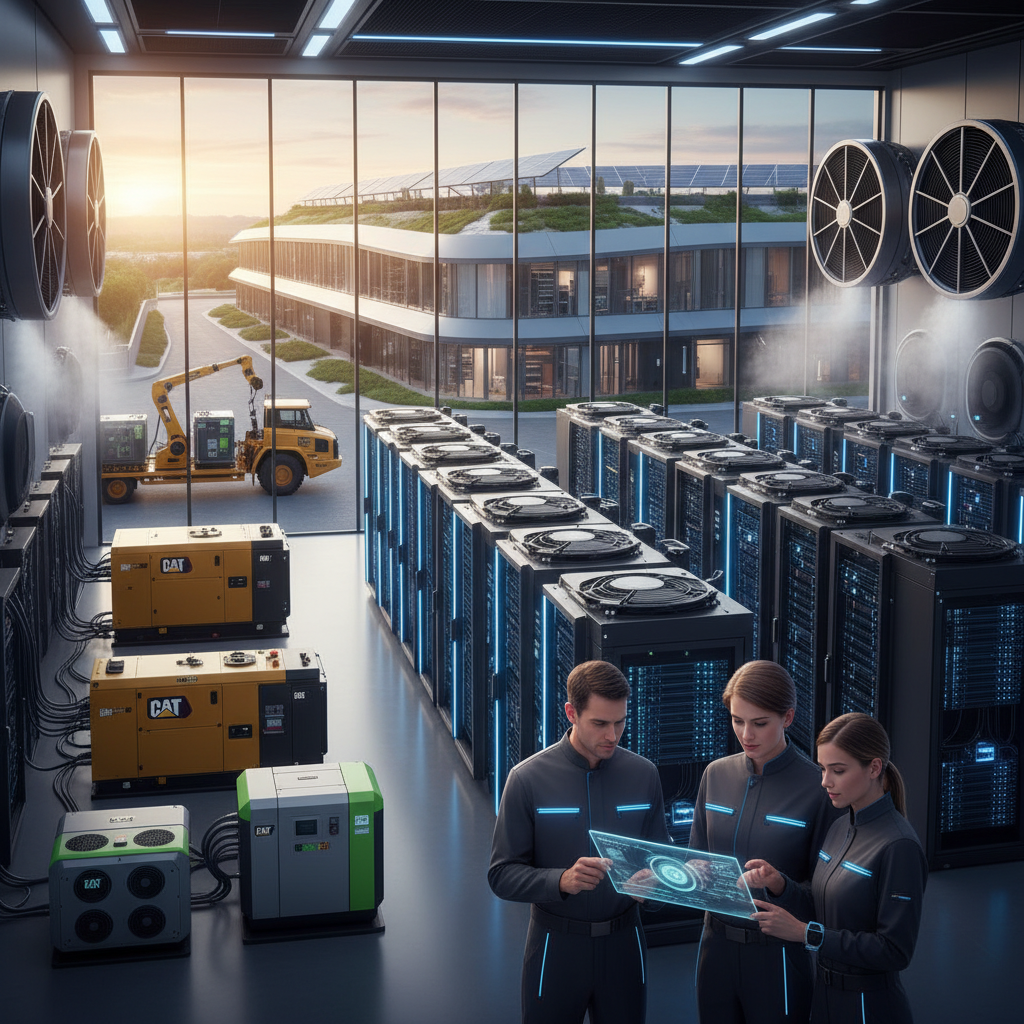
A key area of innovation is the development of modular generator systems that reduce deployment timelines and simplify scalability, addressing the urgent need for rapid expansion in data center power capacity. Caterpillar has introduced advanced models such as the G3520C and G3520K natural gas generator sets, which incorporate enhanced air and fuel system controls to provide superior island mode operational capability and combined cooling, heat, and power (CCHP) functionality. These systems not only supply prime power but also capture waste heat to support cooling of high-density servers, thereby increasing overall energy efficiency.
Recognizing the substantial energy consumption of AI workloads and the critical need for uninterrupted power supply, Caterpillar integrates battery energy storage systems with its generation assets. This integration supports grid-forming capabilities and allows for optimized fuel usage, contributing to emission reductions by enabling blended fuel options including natural gas and hydrogen. The company’s portfolio thus spans from quick-start diesel generators to emerging hydrogen fuel cell technologies, offering flexible and low-emission solutions tailored to diverse customer needs.
In response to the broader industry trend towards sustainable and resilient power infrastructure, Caterpillar has partnered with other technology leaders such as Vertiv to provide pre-designed, integrated power distribution and cooling architectures. This collaboration aims to streamline deployment, accelerate time-to-power, and optimize operational performance of data centers, addressing both reliability and environmental sustainability. Additionally, Caterpillar’s Condition Monitoring Advisors utilize data analytics to monitor equipment health in real time, enabling predictive maintenance and reducing downtime, further enhancing the value proposition for customers.
Through these innovations, Caterpillar not only supports the surging demand for data center power but also actively contributes to improving the sustainability of digital infrastructure. By integrating hybrid power systems that combine renewables, batteries, and conventional fuels, the company is well-positioned to meet evolving environmental regulations and customer expectations in an increasingly energy-conscious market.
Partnerships and Collaborative Projects
Caterpillar’s power and energy division has significantly expanded its market presence through strategic partnerships and collaborative projects that address the surging demand for reliable and scalable power solutions in AI-driven data centers. A notable collaboration is with Vertiv, a global leader in power distribution and cooling technologies. This partnership aims to accelerate time-to-power and optimize operational performance for high-density AI data centers by integrating Caterpillar’s power generation equipment—including its Solar Turbines portfolio—with Vertiv’s modular cooling and electrical distribution systems. The collaboration introduces pre-designed, interoperability-tested architectures that enable concurrent design, build, and deployment processes with predictable system performance, effectively easing pressure on local power grids while enhancing data center efficiency and resiliency.
Another significant initiative involves Joule Capital Partners, which is developing a super-compute-ready campus in Central Utah designed specifically for AI workloads. Spanning 4,000 acres and targeting gigawatt-scale capacity by 2026, this project integrates cutting-edge power generation and scalable infrastructure to deliver high energy efficiency and compute density. Joule’s strategic alliance with Caterpillar and Wheeler Machinery Co. brings together advanced engineering, local expertise, and visionary energy design to provide resilient solutions tailored to future compute demands. This collaboration exemplifies Caterpillar’s commitment to powering the next generation of data center infrastructure and driving large-scale deployment of reliable power systems in emerging markets.
These partnerships highlight Caterpillar’s proactive approach to meeting the rapidly evolving
Impact on Sales, Market Position, and Financial Performance
Caterpillar’s pivot toward supplying power equipment for AI data centers has significantly reshaped its sales dynamics and market positioning. Traditionally reliant on the cyclical construction and mining sectors, which are prone to boom-and-bust fluctuations, Caterpillar’s expanding focus on power generation for AI infrastructure offers a more stable revenue stream that mitigates the volatility associated with its core markets.
This strategic shift has propelled Caterpillar’s power and energy business to become its fastest-growing sales unit. Fueled by an increasing number of data center projects, the company anticipates this segment to drive annual sales growth of 5% to 7% through 2030, outpacing the roughly 4% growth experienced in recent years. In 2025, this growth momentum translated into a remarkable surge in the company’s share price, which rose more than 60% year-to-date, outperforming broader industrial indices and some technology-heavy benchmarks despite ongoing challenges such as tariffs and inflationary pressures.
Financial results from the third quarter further underscore the impact of AI-driven demand. Overall sales reached $17.6 billion, marking a 10% increase year-over-year. The Energy & Transportation unit, which includes power generation, saw a 17% rise in sales to $7.2 billion, with strong contributions from natural-gas generators tailored for AI data centers. Power generation currently accounts for about one-third of this segment and continues to grow as a key revenue driver.
Caterpillar’s diversified energy portfolio — ranging from quick-start diesel generators to natural gas and hydrogen-fueled systems aimed at emission reduction — aligns well with evolving customer preferences for blended energy solutions that balance reliability and sustainability. This versatility positions Caterpillar competitively as data centers increasingly demand large-scale, efficient, and cost-effective power generation solutions to support surging AI, cloud, and video workloads, especially in tech-heavy regions across the United States.
Moreover, the broader energy sector is experiencing renewed growth driven by data center electricity consumption, which is projected to account for over 20% of electricity demand growth in advanced economies by 2030. Renewables and natural gas are expected to lead this surge due to their cost-effectiveness and availability, further validating Caterpillar’s focus on natural gas-powered generation equipment for AI infrastructure.
Case Studies of AI Data Center Deployments
The rapid expansion of AI technologies and the corresponding surge in data center demand have prompted innovative power infrastructure solutions from leading industry players, including Caterpillar. One notable example is the collaboration between Caterpillar and Vertiv, which addresses the heightened need for robust power and cooling systems essential to support energy-intensive AI training clusters. This partnership exemplifies efforts to provide scalable and reliable infrastructure tailored for modern data center operations.
A prominent case study is the agreement announced between Caterpillar, Wheeler Machinery Co., and Joule Capital Partners to power Joule’s High Performance Compute Data Center Campus in Utah. Joule is developing what is poised to be the largest single data center campus in Utah, designed specifically for AI-driven workloads. The campus will deliver up to four gigawatts of power capacity, marking a significant addition to the Intermountain West’s energy infrastructure. This initiative integrates advanced, reliable power generation with scalable infrastructure, aiming to maximize energy efficiency and compute density for next-generation AI computing needs. The facility is scheduled to launch with gigawatt capacity by 2026.
Further emphasizing sustainability, Caterpillar has demonstrated the viability of integrating alternative fuel technologies such as hydrogen fuel cells in data center backup power solutions. These innovations help reduce greenhouse gas emissions by utilizing power generation systems running on 100% natural gas, hydrogen, or blended fuels. Such approaches not only maintain generator health and operational efficiency but also contribute to the environmental goals of modern data center operators.
Another strategic development in AI data center power infrastructure is the adoption of on-site power equipment placement. This approach enables data centers to bypass congested utility grids, accelerating capacity deployment and allowing facilities to operate independently of traditional utility timelines. This model has profound implications for Caterpillar’s business, enabling faster and more flexible power solutions to meet the dynamic needs of AI workloads and cloud computing environments.
Collectively, these case studies illustrate how Caterpillar and its partners are responding to the evolving landscape of AI-driven data centers by delivering innovative, scalable, and sustainable power solutions that support the surging demand for digitalization and artificial intelligence across the United States.
Economic and Environmental Implications
The surge in AI data center demand has significantly impacted Caterpillar’s power and energy division, driving robust economic growth while also prompting a focus on sustainability. Economically, Caterpillar’s power and energy business has become the company’s fastest-growing sales unit, fueled by the rising need for reliable power infrastructure to support AI data centers. This growth is expected to boost Caterpillar’s annual sales by 5% to 7% through 2030, outpacing its recent average of 4% growth. The company is responding with substantial investments, including its largest factory spending in approximately 15 years, to meet the burgeoning demand for AI infrastructure. This growth coincides with projections that electricity demand from data centers will triple by 2035, underscoring the scale of the opportunity Caterpillar is capitalizing on.
From an environmental perspective, Caterpillar integrates sustainability into its energy solutions by offering a broad portfolio that includes quick-start diesel generators, natural gas, hydrogen-fueled generation, and energy storage systems. This blend of energy options enables customers to reduce greenhouse gas emissions while ensuring reliable power. Notably, Caterpillar has demonstrated the viability of hydrogen fuel cell technology for backup power in data centers, such as Microsoft’s facility, highlighting its commitment to emission reduction. Furthermore, leveraging battery energy storage alongside power generation assets helps maintain equipment health and optimize fuel efficiency, aligning operational needs with environmental goals.
Industry experts emphasize the importance of sustainable strategies in managing the escalating energy demands of AI data centers. Simple yet effective measures—such as optimizing AI model training and investing in efficient hardware—can reduce data center electricity demand by 10% to 20%. These sustainability initiatives not only address environmental concerns but also align with financial benefits, as they often require minimal capital expenditure while achieving significant emissions reductions. Caterpillar’s role in supporting data centers to meet rigorous sustainability and reliability standards, including certifications from the Uptime Institute, LEED, and ISO, further cements its position as a critical enabler of both economic growth and environmental stewardship in the AI-driven energy landscape.
Challenges and Future Outlook
The rapid surge in AI data center development has significantly boosted demand for on-site power generation, presenting both opportunities and challenges for Caterpillar’s power and energy division. One of the primary challenges is the reliance on on-site generation as a workaround for congested utility grids and lengthy interconnection queues. While this approach allows data centers to bring capacity online more quickly, it remains uncertain whether it will become a permanent standard or if improvements in grid infrastructure will eventually reduce the need for decentralized power solutions.
Profitability challenges also loom amid this growth. Caterpillar faces margin compression and tariff-related pressures that could impact its premium valuation. Sustaining sales growth and controlling costs will be critical to maintaining investor confidence, especially as the company aims to capitalize on recurring revenue streams from data center energy partnerships through substantial investments, such as the $725 million plant expansion to double turbine production capacity by 2030.
Looking ahead, innovation will be key to maintaining Caterpillar’s competitive edge in a market increasingly focused on sustainability and efficiency. The generator solutions market is expected to be dominated by modular systems that reduce deployment timelines, hybrid power systems that integrate renewables and storage to lower emissions and operating costs, and smarter controls that enable predictive maintenance and optimized power usage. These technological advancements will allow Caterpillar and its peers to meet the evolving demands of data centers while addressing environmental concerns.
Moreover, the integration of alternative fuel sources, such as natural gas and hydrogen, along with combined heat and power (CHP) systems that reclaim waste heat, exemplifies how Caterpillar is adapting its offerings to support more sustainable and efficient data center operations. Collaborations with companies like Vertiv to streamline complex power system construction also reflect a strategic emphasis on modular and hybrid solutions tailored to high-density computing environments.
Despite these promising developments, the long-term outlook carries risks. Should grid congestion ease through investments in infrastructure and smarter grid management, the current demand for on-site generation may diminish, potentially affecting Caterpillar’s growth trajectory in this sector. Consequently, the company’s ability to innovate and adapt to changing energy landscapes will be crucial to sustaining its position in the fast-evolving AI data center power market.
The content is provided by Sierra Knightley, 11 Minute Read