Summary
Irans Bold Warning Retaliation on the Table if the US Escalates Attacks Amid Protests details the heightened tensions between Iran and the United States during a period of widespread domestic unrest in Iran that began in late 2024. Sparked initially by economic grievances, these protests evolved into the largest anti-government demonstrations in years, leading to a severe crackdown by Iranian authorities marked by violent clashes, mass arrests, and over 600 deaths. The Iranian government accused the United States and Israel of fomenting the unrest as part of a broader foreign-backed destabilization campaign, framing the protests within a complex geopolitical struggle that heightened regional instability.
Against this backdrop, Iran issued stark warnings that any further U.S. military action would provoke retaliation not only against Israel but also against American military assets throughout the Middle East. Tehran’s recalibrated security posture, which now includes responding to “objective signs of threat” rather than awaiting direct attacks, signals a more ambiguous and potentially preemptive defense doctrine that has raised international concern over the risk of miscalculation and escalation. Iranian officials, including Supreme Leader Ayatollah Ali Khamenei and Parliament Speaker Mohammad Baqer Qalibaf, publicly threatened broad retaliation, emphasizing the regime’s resolve amid escalating U.S. rhetoric and military strikes on Iranian nuclear sites.
The United States responded with warnings aimed at deterring Iranian aggression while simultaneously expressing concern over Iran’s human rights abuses and suppression of protesters. Although President Donald Trump’s administration signaled readiness for possible military action—using phrases such as “locked and loaded and ready to go”—no significant troop deployments or overt escalations were publicly confirmed, reflecting a cautious approach to a volatile situation with unpredictable consequences for regional and global stability. U.S. agencies have also warned of possible retaliatory attacks or cyber operations by Iran targeting American interests, underscoring the broader security implications of the crisis.
Internationally, the conflict has intensified diplomatic realignments and economic pressures, with renewed UN sanctions on Iran and increased reliance by Tehran on allies like China and Russia. Regional actors have expressed concerns about the reliability of U.S. security guarantees, prompting some to explore rapprochement with Iran. The convergence of internal dissent, international pressure, and ambiguous military doctrines contributes to a precarious security environment, where expert analysts caution that missteps could lead to wider conflict with profound implications for Iran, the Middle East, and beyond.
Background
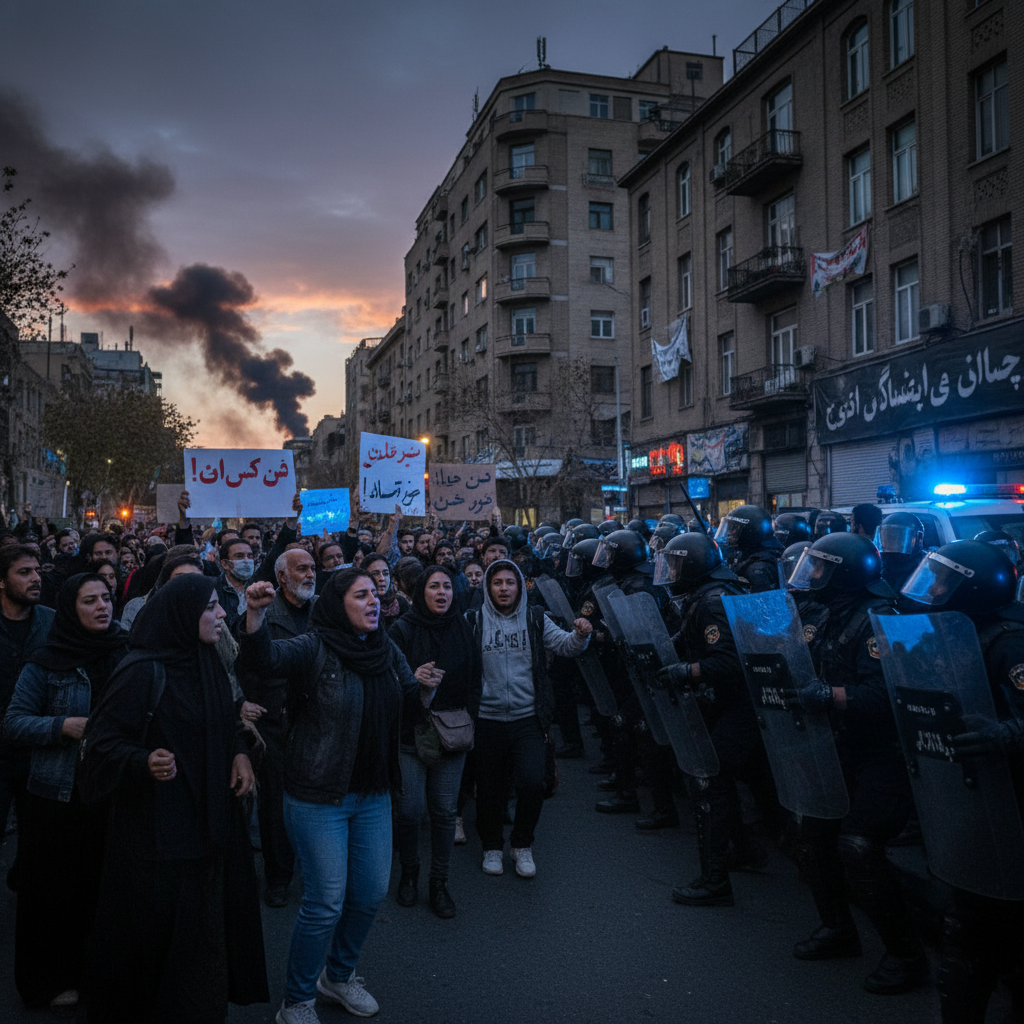
In late 2024 and early 2025, Iran experienced widespread protests that began primarily over economic grievances, including the impact of currency fluctuations on daily life and business, particularly in bazaars such as the Tajrish Bazaar in Tehran. These demonstrations quickly evolved into the largest anti-government protests in years, spreading across multiple provinces including Isfahan and Kerman. The protests were met with a harsh crackdown by Iranian authorities, resulting in violent clashes, numerous arrests, and over 600 deaths.
The Iranian government responded to the unrest with measures including a near-total internet blackout, which extended beyond 60 hours in an attempt to curtail communication and organization among protesters. Officials threatened severe punishments, including the death penalty, labeling the protests as “a war against God,” with public declarations by figures such as Prosecutor Ali Salehi and Parliament Speaker Mohammad Baqer Qalibaf emphasizing a harsh response. At the same time, Iranian President Masoud Pezeshkian called for restraint and dialogue, urging authorities to listen to the demands of the people while avoiding violence.
The protests occurred against a backdrop of significant geopolitical tension and internal uncertainty. Iran’s Supreme Leader Ayatollah Ali Khamenei called for unity in the face of what he termed “terrorist actions,” highlighting concerns over foreign interference, particularly from the United States and Israel. Iranian officials repeatedly accused these countries of instigating or exacerbating the unrest, framing the protests as part of a broader campaign of destabilization. Iranian Foreign Minister Abbas Araghchi emphasized the role of US and Israeli involvement, noting that the demonstrations were unlike typical protests in other countries due to this external influence.
Meanwhile, Iran’s security establishment publicly adjusted its defense posture, declaring that Tehran would no longer limit its responses to attacks but would also consider “objective signs of threat” in its security calculations. This statement signaled a more ambiguous and potentially pre-emptive approach to perceived threats amid heightened tensions with the United States and Israel, both of which had intensified rhetoric and hinted at possible strikes against Iran’s nuclear program. The regional environment remained volatile, with Iranian-backed groups weakened and international sanctions reimposed, further straining Iran’s position.
The United States expressed concern over the crackdown on protesters and the deteriorating human rights situation, calling for an end to violence and intimidation. However, US officials also warned that intervention risked escalating into a broader conflict with unpredictable consequences for both the region and Iranian citizens. Iranian leaders responded to such threats with warnings of retaliation against both Israel and the United States, underscoring the potential for the protests and international tensions to intersect in a dangerous escalation.
Taken together, these factors created a complex environment of internal dissent, external pressure, and strategic recalibration in Iran, setting the stage for the bold warnings issued by Tehran regarding retaliation if US actions were to escalate amidst the ongoing unrest.
Events Leading to the Warning
The warning from Iran regarding potential retaliation against the United States emerged amid a backdrop of escalating tensions both domestically and internationally. Internally, Iran faced its largest anti-government protests in years, which initially began over economic grievances but soon evolved into widespread demonstrations challenging the regime’s authority. Dozens of protesters took to the streets across multiple provinces, with some protests turning deadly following clashes with police forces. Iranian officials responded with stern warnings against any US intervention, emphasizing the risks of external involvement in the country’s internal affairs.
Concurrently, the geopolitical environment surrounding Iran became increasingly volatile. The Iranian Defense Council issued its first official statement in January 2026, condemning what it described as “intensifying threatening language and interventionist threats” from adversaries, particularly targeting the United States and Israel. This statement followed heightened rhetoric and warnings from US President Donald Trump about potential military responses should the Iranian government continue to suppress protesters violently. In response, Iran’s parliament speaker, Mohammad Baqer Qalibaf, delivered a stark warning to the US and Israel, declaring that any attack on Iran would render both Israel and all US military bases and assets in the region legitimate targets for retaliation.
This period of heightened tension was further complicated by Iran’s recalibration of its security doctrine. While Tehran reiterated its long-standing claim of not seeking war, the Iranian council declared that it would no longer limit its response to actual attacks but would also consider “objective signs of threat” within its security calculus. This shift subtly broadened the scope of Iran’s definition of legitimate self-defense, raising concerns about miscalculations and unintended escalation, especially in the absence of direct communication or de-escalation mechanisms between involved parties.
Moreover, external fears were fueled by events such as the recent capture of Venezuelan President Nicolas Maduro, which heightened Iranian anxieties over possible covert operations aimed at the regime’s leadership. The FBI and Department of Homeland Security issued warnings about potential hostile acts or cyber-attacks by Iran targeting critical infrastructure within the United States, indicating a rising threat environment linked to the ongoing conflict. Meanwhile, opposition figures and elements within the protest movement voiced support for change, with some rallying around figures like Crown Prince Reza Pahlavi, reflecting the growing challenge to the Islamic Republic’s rule.
In sum, the confluence of intense domestic unrest, assertive international posturing, and shifting defense doctrines contributed to Iran’s bold warning of retaliation if the United States escalated attacks or intervention during the ongoing protests. This environment underscored the fragility of the situation and the high risks of further escalation on all sides.
Details of the Warning of Retaliation
Following the U.S. military strikes on Iranian nuclear sites, Iranian officials have issued increasingly explicit warnings of retaliation. Iran reportedly maintains a longstanding objective to target officials perceived as responsible for such attacks, with the Department of Homeland Security (DHS) noting heightened rhetoric from Iranian leaders pledging reciprocal action. Maj. Gen. Amir Hatami, Iran’s army chief, stated that the intensification of hostile rhetoric against Iran would not go unanswered, a message reinforced by Supreme Leader Ayatollah Ali Khamenei who declared that “rioters must be put in their place,” effectively sanctioning escalated repression in response to unrest.
Iranian Parliament Speaker Mohammad Baqer Qalibaf explicitly threatened that in the event of a U.S. or Israeli attack, both Israel and U.S. military centers, bases, and shipping in the region would be considered legitimate targets for retaliation. This stance represents a broader shift in Tehran’s security doctrine, as the country now considers “objective signs of threat” sufficient grounds for defensive action, rather than waiting for direct attacks to occur. The Iranian military has vowed to defend national interests amid widespread protests and an internet blackout intended to suppress dissent.
The warnings come amid a backdrop of U.S. warnings about the heightened threat environment inside the United States from Iranian entities or their supporters, following strikes on Iran. The FBI and DHS have cautioned U.S. authorities and citizens abroad about potential retaliatory acts, including hostile operations or cyber-attacks aimed at disrupting critical infrastructure. Meanwhile, Iranian officials continue to frame domestic protests as part of a foreign-backed campaign to destabilize the country, accusing the U.S. and Israel of using “hybrid methods” against Iran.
Despite these escalations, the U.S. military has stated that its forces in the Middle East remain postured to defend U.S. interests, allies, and partners but has not significantly altered troop levels in response to the tensions. The overall situation remains highly volatile, with the potential for miscalculation heightened by ambiguous threat definitions and reciprocal signaling between Iran, the U.S., and Israel.
Timeline of Major Statements and Developments
In early January 2026, the newly established Iranian Defense Council issued a brief yet significant statement declaring that Iran “does not consider itself limited to reaction after an action” and would treat “objective signs of threat” as part of its security calculus. This marked a shift toward a more ambiguous and potentially preemptive security posture, raising concerns over miscalculation given Israel’s longstanding permissive preemptive use-of-force doctrine.
On January 2, U.S. President Donald Trump issued warnings regarding Iran amid ongoing protests within the country, which Iranian authorities perceived as interventionist threats. In response, on January 6, the Iranian Defense Council condemned this intensifying rhetoric and warned it would take unspecified preemptive measures to counter any U.S. or Israeli attempts to exploit the unrest to threaten regime security. Around the same time, Maj. Gen. Amir Hatami, Iran’s army chief, declared that the Islamic Republic considered the escalation in hostile rhetoric a threat that would not go unanswered.
Meanwhile, the Iranian regime issued a sharp warning that any U.S. military attack would provoke retaliation not only against Israel but also against American military bases throughout the Middle East, underscoring its broad retaliatory capabilities. This warning was echoed by Supreme Leader Ayatollah Ali Khamenei, who urged the U.S. to “focus on his own country,” blaming America for inciting the protests and insisting on strong measures against rioters, effectively sanctioning escalated repression by security forces.
In the aftermath of U.S. strikes on Iranian nuclear sites, U.S. agencies heightened alerts for possible retaliation from Iranian-backed groups. The FBI warned of an elevated threat to U.S. interests and citizens abroad, and the State Department issued a worldwide caution for Americans due to the risk of demonstrations and potential attacks linked to Iran’s pledged reciprocal actions. Despite aggressive rhetoric from both sides, U.S. officials stated that no significant changes had been made to troop deployments in the Middle East, though statements such as “We are locked and loaded and ready to go” heightened tensions and drew sharp Iranian backlash.
The protests inside Iran continued to pose a complex challenge. While some U.S. rhetoric aimed to support dissenters, analysts warned that direct intervention risked escalating conflict unpredictably. Iranian leadership responded by tightening control and mobilizing loyalists, with public broadcasts warning parents to keep children off the streets for their safety and reinforcing a posture of defiance rather than compromise.
US and International Reactions
The United States responded to the unrest and escalating tensions in Iran with a mixture of stern warnings and cautious military posturing. On January 2, then-President Donald Trump declared on Truth Social that if Iran were to “shoot and violently kill peaceful protesters,” the United States would come to their rescue, though he did not specify what actions might be taken. This statement marked a notable shift, linking Iran’s internal repression with potential external consequences, a linkage that had traditionally been compartmentalized by the US administration. Despite rhetoric suggesting possible military intervention—Trump’s post included the phrase “locked and loaded and ready to go”—US officials clarified that no major changes to troop levels or preparations had occurred in the Middle East. Earlier, in June, the US had launched strikes against Iran’s nuclear sites on Trump’s orders, which American officials claimed significantly delayed Tehran’s nuclear ambitions, a claim Iran disputed. In retaliation, Iran launched a missile attack on a US military base in Qatar.
Iranian officials condemned the US threats sharply. Iran’s Parliament Speaker Mohammad Bagher Ghalibaf warned that US bases and forces in the Middle East would become legitimate targets if the US pursued what he termed “adventurism”. Former IRGC Commander Mohsen Rezaei further asserted that any hostile action against Iran would result in the destruction of Israel, US bases, and regional stability. Similarly, Supreme National Security Council Secretary Ali Larijani cautioned that US interference in the protests could destabilize the Middle East and harm US interests, urging the US to prioritize the safety of its soldiers. Supreme Leader Ayatollah Ali Khamenei publicly accused President Trump of inciting the protests and called for national unity, dismissing the unrest as instigated by “a bunch of vandals” acting to please the US.
Internationally, the reimposition of UN sanctions against Iran—restoring an arms embargo, restrictions on uranium enrichment and ballistic missile activity, asset freezes, and travel bans—received strengthened backing following the conflict, despite opposition from Russia and China who proposed delaying the sanctions. Iranian state media highlighted the growing strategic alliance between Iran, Russia, and the People’s Republic of China (PRC), noting their use of “shadow fleets” to evade sanctions as evidence of an emerging economic-political bloc. This cooperation is viewed as crucial for sustaining Iran’s economy amid mounting pressure.
Other regional actors expressed concern over the US’s reliability as a partner for security, with reports indicating that some Arab allies pursued diplomatic relations with Iran due to doubts about American commitment. Iranian Foreign Minister Abbas Araghchi accused the US and Israel of interfering in the protests, framing the unrest as part of a foreign-backed campaign designed to destabilize the country. Iran’s judiciary and security officials have also taken a hardline stance, declaring no leniency for those accused of aiding foreign enemies and deploying the regular army alongside police and paramilitary forces to suppress the protests—an escalation from prior responses involving mainly police units.
The volatile mix of US rhetoric, Iranian defiance, and international sanctions has further narrowed diplomatic options and heightened the risk of renewed escalation, with both sides signaling readiness to respond forcefully to perceived threats. The situation remains precarious, with the possibility of broader regional destabilization should tensions continue to rise.
Impact on Regional and Global Stability
The ongoing tensions between Iran, the United States, and Israel have significantly affected both regional and global stability. Since 2023, Iran’s regional influence has deteriorated amid the elimination of leaders from Iran-backed armed and proscribed terrorist groups, weakening their operational strength in the Middle East conflict. The US and Israel’s 2025 strike on Iran’s nuclear program, followed by the reimposition of UN sanctions, has further exacerbated Iran’s economic difficulties and regional position.
Economically, Iran has become increasingly dependent on China as its primary oil customer, a development driven by international sanctions and restricted trade options. This dependency, combined with foreign investor withdrawal and capital flight
Media Coverage and Public Perception
Iranian state media has portrayed the ongoing protests as part of a foreign-backed destabilization campaign, emphasizing control and downplaying dissent. State TV reported on casualties among security forces while largely omitting details about demonstrator deaths, referring to protesters increasingly as “terrorists” and highlighting pro-government demonstrations to project normalcy across the country. The semi-official Fars news agency, linked to the Iranian Revolutionary Guards, released surveillance footage purportedly from protests in Isfahan, signaling an attempt to shape the narrative surrounding the unrest.
Government officials have consistently framed the protests as influenced or orchestrated by external actors, particularly the United States and Israel. Iranian Foreign Minister Abbas Araghchi explicitly accused these nations of intervening in the demonstrations, urging observers to consider statements from both countries as evidence of their interference. Similarly, judiciary chief Gholamhossein Mohseni Ejei condemned protesters as collaborators with Iran’s enemies and labeled the unrest part of a “hybrid” campaign to destabilize the nation.
On the other hand, international media and foreign governments have expressed concern over the Iranian authorities’ handling of the protests. The U.S. State Department condemned reports of intimidation, violence, and mass arrests of demonstrators and called for an end to the crackdown, reflecting broader worries about human rights abuses and the suppression of dissent. The protests, initially sparked by economic grievances, have evolved into widespread anti-government demonstrations, drawing significant global attention and scrutiny.
Public perception within Iran appears divided. While state media emphasizes the threat posed by foreign interference and portrays security efforts as defending national interests, opposition voices seek to maintain pressure on the government, hoping to induce defections among key figures or force concessions. The government’s narrative aims to instill fear to suppress protests without providing justification for foreign intervention, a delicate balance amid escalating tensions and an internet blackout intended to curtail communication among demonstrators.
Analysis and Expert Commentary
The intensification of rhetoric between Iran and the United States amid ongoing protests in Iran has prompted a complex strategic environment marked by heightened tensions and potential risks of escalation. Experts highlight that the Iranian leadership views increased hostile discourse as a direct threat, signaling a readiness to respond firmly should provocations continue. Maj. Gen. Amir Hatami, Iran’s army chief, has issued warnings widely interpreted as directed at Washington, reinforcing a posture of deterrence and readiness to act against perceived aggression.
Iranian officials frame the domestic unrest not merely as spontaneous protests but as components of a foreign-backed campaign, specifically implicating the United States and Israel in efforts to destabilize the country through what they term “hybrid methods”. This narrative is used to justify a hardline response, as reflected in Supreme Leader Ali Khamenei’s call for security forces to suppress rioters decisively, effectively sanctioning escalated repression. Analysts like Naysan Rafati of the International Crisis Group note that the protests stem from deep and widespread economic malaise, suggesting underlying societal discontent beyond the influence of foreign interference.
The strategic calculus of Iran has evolved, with the government signaling a shift from a strictly reactive defense posture toward a broader interpretation of legitimate security responses. While Tehran continues to assert it does not seek war, official statements suggest that it would consider “objective signs of threat” as justification for preemptive measures, albeit expressed in cautious terms that avoid explicit endorsement of preemption. This nuanced stance arises amid increased concerns about potential decapitation strikes or targeted operations against Iranian leadership, especially in light of recent geopolitical developments such as the capture of Venezuelan President Nicolas Maduro, which has heightened Iranian fears of similar tactics.
The asymmetry in military doctrines further complicates the risk environment. Israel maintains a permissive, openly preemptive approach to the use of force, contrasting with Iran’s more restrained public posture. The absence of direct strategic communication channels exacerbates the potential for miscalculation, as ambiguous threat definitions and reciprocal signaling increase the likelihood of unintended escalation.
From the U.S. perspective, policymakers face a strategic dilemma. Ali Vaez, director of the Iran Project at the International Crisis Group, underscores the challenge of balancing deterrence and the risk of wider conflict. Failure to act decisively could embolden the Iranian regime and suppress internal dissent, yet aggressive intervention risks spiraling into broader confrontation with unpredictable consequences for both nations and the Iranian populace. Additionally, U.S. policy toward Iran remains intertwined with broader regional dynamics, including strained relations with Gulf allies who seek stronger security commitments to counter Iranian influence.
Moreover, the situation is complicated by Iran’s internal measures such as internet blackouts, which have been criticized by monitoring groups as threats to civilian safety during a critical juncture for the country’s future. The convergence of domestic unrest, foreign policy posturing, and shifting military doctrines creates a volatile environment where expert analyses caution that clarity in communication and careful management of signaling will be essential to prevent escalation.
The content is provided by Harper Eastwood, 11 Minute Read