
Summary
Exploring Troop Costs: How China’s Role Shapes the Agenda in Lee’s Meeting with Trump examines the strategic and financial dimensions of the U.S.-South Korea alliance amid evolving regional security dynamics influenced by China’s rising power. Central to this topic is South Korean President Lee Jae-myung’s high-profile 2023 meeting with former U.S. President Donald Trump, which focused on strengthening bilateral ties, addressing defense cost-sharing for U.S. troops stationed in South Korea, and navigating the complex geopolitical challenges posed by China’s expanding military and economic influence in East Asia.
The alliance between the United States and South Korea, forged during the Korean War, remains a cornerstone of regional stability, with Seoul hosting approximately 28,500 American troops and contributing over $1 billion annually toward their maintenance and infrastructure, including funding the construction of Camp Humphreys. However, Trump’s administration pushed for increased financial contributions from South Korea, sparking contentious negotiations amid broader strategic recalibrations designed to counterbalance China’s assertiveness. These discussions have been complicated by South Korea’s efforts to balance strong support for the U.S. alliance with maintaining nuanced diplomatic and economic relations with Beijing.
China’s growing regional ambitions—manifested through military modernization, economic investments, and strategic initiatives—have significantly shaped the agenda during Lee and Trump’s meeting, elevating concerns about the future security architecture of the Indo-Pacific. The summit underscored trilateral cooperation among the U.S., South Korea, and Japan as a key mechanism to deter Chinese influence, while also highlighting the risks of escalating tensions if diplomatic stability is not carefully managed. Experts emphasize that the interplay between defense cost-sharing and regional security concerns reflects the broader challenge of maintaining a robust alliance without alienating China or provoking conflict.
The article further explores the political and strategic implications of these developments, including debates over South Korea’s potential nuclear capabilities and how Beijing’s perceptions of these shifts could affect regional stability. It also considers the enduring complexity of U.S.-China relations, shaped by historical legacies, ongoing military competitions, and economic interdependence, all of which influence alliance management and security policy on the Korean Peninsula and beyond.
Background
The longstanding military alliance between the United States and South Korea has been a central pillar of security on the Korean Peninsula since the Korean War. Seoul currently hosts approximately 80,000 U.S. troops, supported by substantial financial contributions from South Korea itself. The country provides over $1 billion annually to sustain the U.S. military presence and has invested heavily in infrastructure, including funding the construction of Camp Humphreys, the largest U.S. overseas base. These cost-sharing arrangements have evolved through a series of Special Measures Agreements, with South Korea paying close to $830 million in 2017 alone, accounting for roughly half of the non-personnel costs of U.S. forces stationed in the region.
Against this backdrop, the strategic focus of the alliance has been shifting in response to China’s rising influence in East Asia. Beijing’s expanding economic and military capabilities, including its significant infrastructure investments and a major military buildup by the People’s Liberation Army (PLA), have altered regional dynamics and raised concerns among U.S. policymakers and their allies. The war in Ukraine and heightened tensions over Taiwan have further underscored the strategic competition between the U.S. and China, with Washington increasingly prioritizing efforts to counterbalance Beijing’s ambitions.
In response, there have been efforts to revitalize trilateral cooperation between South Korea, the United States, and Japan as a networked security architecture aimed at enhancing regional stability and deterring Chinese influence. However, this arrangement faces challenges, including balancing military deterrence with diplomatic stability, particularly on the Korean Peninsula and across Taiwan Strait issues.
South Korea’s leadership, including President Lee Jae-myung, has expressed full support for the U.S. alliance while navigating complex regional pressures. Lee’s government continues to engage with Washington on security concerns related to China and North Korea, as well as ongoing negotiations regarding Seoul’s financial contributions to U.S. forces. Additionally, discussions have included potential amendments to civilian nuclear energy agreements to expand Seoul’s capabilities in uranium enrichment and spent fuel reprocessing, reflecting broader security considerations in the region.
Lee’s Meeting with Trump
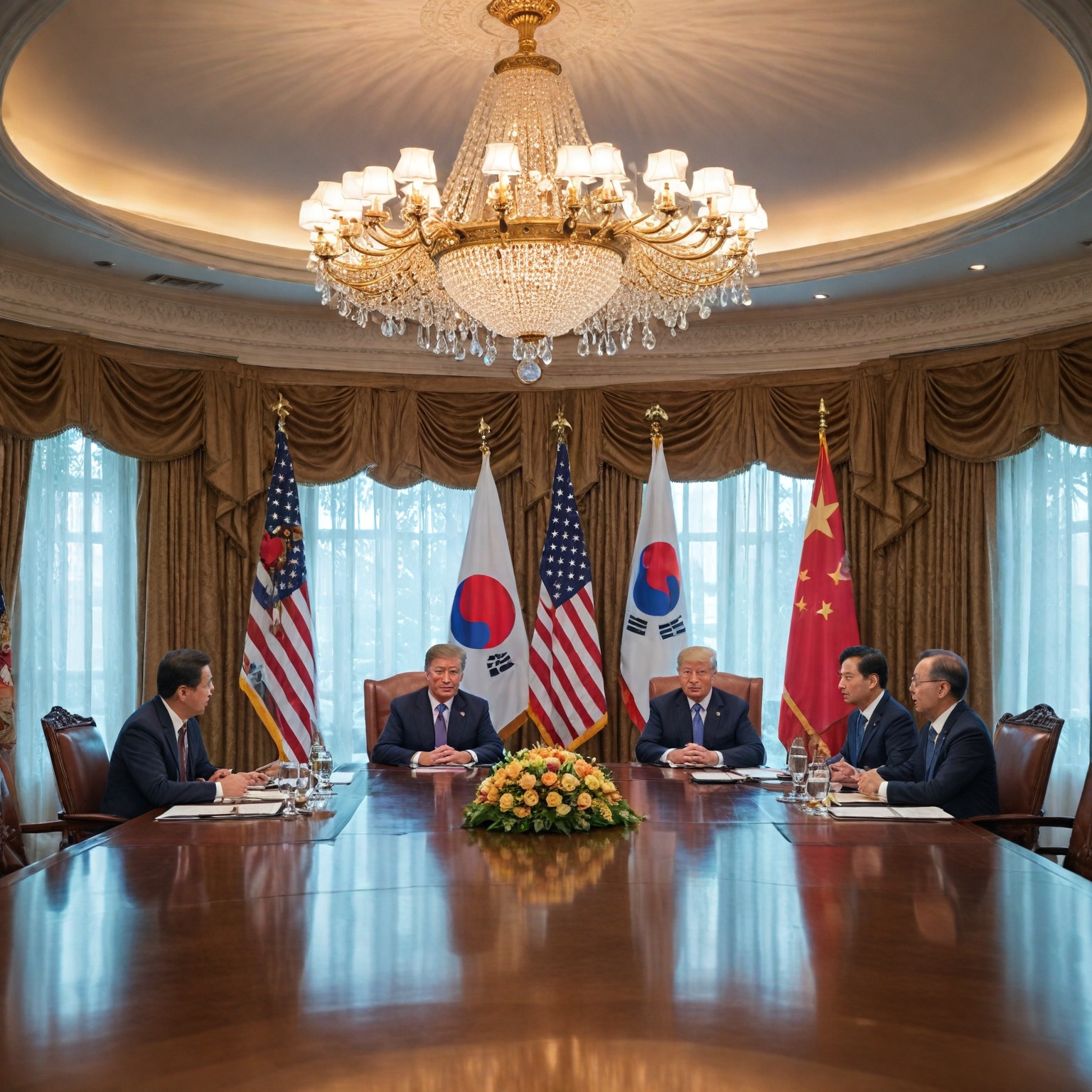
South Korean President Lee is scheduled to travel to the United States for a three-day visit beginning on a Sunday, marking his first high-stakes meeting with then-President Donald Trump. The summit, held on August 25 in Washington, D.C., aims to strengthen the bilateral alliance and deepen economic security partnerships, including advancing cooperation in the manufacturing sector based on a recently signed tariff deal. This meeting is viewed as a significant step toward establishing a “future-oriented, comprehensive strategic alliance” amidst evolving global security and economic challenges.
Key topics on the agenda include trade, defense, and regional security concerns. Lee’s National Security Adviser, Wi Sung-lac, indicated that while trade and defense are priorities, Lee will urge Trump to take concrete steps to rebuild trust with North Korea. Seoul has expressed willingness to increase contributions to joint military capabilities and is engaged in discussions regarding higher defense spending, reflecting a broader international trend among allies such as NATO members who are pledging to enhance their defense budgets.
A significant undercurrent in the summit discussions is the strategic challenge posed by China. U.S. officials are seeking to recalibrate the alliance to better address the threats from China, including how U.S. forces in South Korea might be leveraged in this context. This focus introduces complexities for Lee, who has expressed full support for the U.S. yet must navigate the intricate dynamics of regional security. Experts note that while China’s economic interdependence with the U.S. complicates direct comparisons to Cold War-era rivalries, the China-U.S. relationship is shaping the geopolitical landscape of the 21st century. Furthermore, concerns persist regarding China’s economic strategies and investments in the region, which may carry coercive elements and create strategic vulnerabilities.
China’s Influence on the Meeting’s Agenda
China’s growing regional influence significantly shaped the agenda during Lee Jae-myung’s meeting with then-President Donald Trump. Both South Korea and the United States perceive China’s ambitions as a central factor in their strategic calculations, particularly regarding military presence and economic cooperation in the Indo-Pacific region. Despite the differences between the two U.S. allies, South Korea and Japan, their heavy reliance on Washington to counterbalance China’s rise remains clear, underscoring the importance of trilateral cooperation in the area.
A key point of discussion was the financial arrangements surrounding the U.S. military presence in South Korea. Trump had long pushed Seoul to increase its defense cost-sharing contributions for hosting approximately 28,500 American troops, a legacy of the Korean War. However, uncertainties lingered due to the absence of a formal written agreement detailing how the fund would operate or whether defense costs would be incorporated more comprehensively into trade negotiations, highlighting the complexity of intertwining security commitments with economic interests.
South Korea’s balancing act between Washington and Beijing also emerged as a critical theme. Lee expressed full support for the U.S. alliance but vowed to maintain a nuanced approach toward China, recognizing the latter’s expanding regional role and the potential risks of escalating tensions, especially in light of Taiwan’s disputed status and China’s broader military ambitions in East Asia. U.S. military leadership has cautioned that while South Korea may not be directly involved in potential conflicts such as over Taiwan, regional instability could necessitate American forces stationed in South Korea to address broader security challenges.
China’s economic and strategic initiatives, including investments in infrastructure across Asia, have allowed Central Asian states and others to leverage Beijing’s ambitions to advance their own priorities, though concerns remain about the coercive nature of China’s economic influence and its potential to create vulnerabilities. This backdrop informs why discussions around defense cost-sharing and alliance management are deeply intertwined with apprehensions about China’s growing assertiveness and its impact on regional security dynamics.
Specific Discussions on Troop Costs and Financial Contributions
Discussions between South Korean President Lee Jae-myung and former U.S. President Donald Trump have prominently featured the topic of troop costs and financial contributions toward the maintenance of American forces stationed in South Korea. This issue has long been contentious, stemming from the presence of approximately 28,500 U.S. troops on the Korean Peninsula, a legacy of the 1950-1953 Korean War.
Despite Seoul’s substantial contribution of over $1 billion annually to support the U.S. military presence, including funding for facilities such as Camp Humphreys, the largest U.S. base overseas, the Trump administration pressed for increased burden sharing, seeking a higher financial commitment from Seoul. This push created challenges for Lee, who expressed full support for the U.S. alliance but emphasized a balanced approach between Washington and Beijing.
In March 2021, following a period of stalled negotiations that resumed after President Biden took office, South Korea and the United States reached a new five-year cost-sharing agreement. This deal entailed a 13.9% increase in South Korea’s financial contribution in that year alone, reflecting Seoul’s willingness to engage in dialogue over defense expenditures despite lingering uncertainties about the practical implementation of the fund and the broader framework for cost-sharing.
More recently, a short-term agreement was signed to increase South Korea’s contribution to 1.03 trillion won (approximately £687.68 million), up from 960 billion won in 2018. Unlike previous five-year agreements, this deal is set to expire after one year, potentially necessitating renewed negotiations in the near future. South Korean Foreign Minister Kang Kyung-wha described the process as lengthy but ultimately successful.
The discussions around troop costs are also intertwined with broader strategic considerations. U.S. military officials have noted that while it is not predetermined that South Korea would be involved in conflicts such as any potential Taiwan crisis, the interconnected nature of regional security means that U.S. forces in Korea could be called upon to address larger geopolitical challenges. This dynamic further complicates the negotiations over cost-sharing, as Seoul navigates its alliance with Washington alongside its economic and diplomatic ties with China.
South Korean political leaders, including Lee Jae-myung and other presidential candidates, have indicated openness to continuing discussions on defense cost-sharing agreements, reflecting the ongoing importance of this issue in bilateral relations.
Analyses and Expert Opinions
Experts emphasize the complexity and significance of China’s role in shaping the strategic dialogue during the meeting between South Korea’s President Lee and former U.S. President Trump. Jonathan Corrado highlights how cognitive biases, such as the expectation of continuity and overattribution of causality, influenced perceptions of China’s intervention in the Korean War, reflecting deep-rooted historical contexts that still affect U.S.-China relations today.
Analysts observe that trilateral cooperation between South Korea, the United States, and Japan has been revitalized as a key component of the regional security architecture aimed at counterbalancing China’s growing influence. This networked security framework is expected to persist irrespective of political changes in South Korea, underlining a shared commitment to maintaining regional stability and economic growth despite evolving leadership. Furthermore, despite shifts in alliance management styles, the broad direction of these partnerships remains aligned with confronting common threats posed by China’s rise.
Economic and military dimensions of China’s expanding role also receive considerable attention. One expert cautions that although China’s investments in ports and infrastructure may not easily translate into direct military advantages, the coercive potential embedded in these economic efforts could create strategic vulnerabilities and political leverage in the region. This dual nature of China’s approach requires close scrutiny from American policymakers to anticipate possible shifts toward a more assertive military posture in East Asia.
The military buildup of the People’s Liberation Army (PLA), accelerated by China’s economic rise and further intensified by external conflicts such as the war in Ukraine, adds another layer of concern. South Korea’s security calculus is increasingly influenced by these developments, particularly with regard to Taiwan and the broader balance of power in East Asia.
In the realm of technology and trade, the United States has introduced new export controls aimed at slowing China’s rapid advancement in high-tech sectors. This move is part of a broader strategy to address national security concerns and foreign policy objectives in the face of China’s growing capabilities. The 2022 G20 summit meeting between President Biden and President Xi Jinping, which lasted over three hours, underscored the critical importance of these issues, including tensions over Taiwan, North Korea, and the ongoing conflict in Ukraine.
Finally, analysts recognize that Beijing has strategically employed a combination of blunting and building tactics to limit U.S. influence in Asia and lay the groundwork for regional dominance. While these efforts have met with considerable success, China’s ambitions extend beyond the Indo-Pacific, signaling a far-reaching geopolitical agenda that continues to shape alliance dynamics and security considerations across the region.
Reactions and Political Responses
The reaction to China’s intervention in the Korean War continues to influence contemporary political dynamics and alliance management in East Asia. President Truman’s initial shock at Chinese forces being compelled to engage U.S. troops underscored a broader cognitive bias—the tendency to expect continuity and attribute causality based on limited data—which still shapes perceptions of China’s strategic behavior. The People’s Liberation Army (PLA) employs a doctrine of “self-defensive counterattack,” which involves delivering sudden, forceful blows to shift the adversary’s risk calculations and push toward political negotiations favorable to the PRC. This strategy has been applied not only in Korea but also in conflicts with India and Vietnam.
China’s regional ambitions, however, are constrained by external factors such as Russia’s sustained interest in the area and widespread public wariness, a dynamic described as “warm politics, cold public.” Furthermore, China’s domestic policies, particularly the repression of ethnic Muslim minorities, have adversely affected cross-border relations and diplomatic goodwill.
In South Korea, political leadership changes are poised to impact the U.S.-South Korea alliance. Although the alliance is expected to persist, opposition Democratic Party leader Lee Jae-myung—likely to replace President Yoon Suk Yeol amid impeachment proceedings—may create tensions with Washington. Lee’s anticipated resistance to previous U.S. demands for increased South Korean financial contributions to defense underscores this potential friction. This is notable given that recent negotiations resulted in South Korea tentatively agreeing to a 13% increase in defense contributions, raising the total to just over $1 billion. Despite this, U.S. military officials, including General Xavier Brunson, commander of U.S. Forces Korea, have praised South Korea’s defense investments and procurement of American weapons, emphasizing the enduring partnership between the two nations.
The evolving trilateral security arrangement between the United States, Japan, and South Korea has drawn mixed assessments. Experts caution that an exclusive focus on military deterrence could inadvertently escalate regional tensions and conflict risk. Instead, a more balanced approach is recommended—one that promotes stability on the Korean Peninsula, reaffirms long-standing policies on Taiwan, and deters China from pursuing its own trilateral military partnerships with North Korea and Russia. U.S. strategic competition with China increasingly frames Taiwan as a pivotal geostrategic issue, influencing alliance policies and regional security considerations.
Implications for Future US-South Korea and US-China Relations
The evolving strategic competition between the United States and China has profound implications for the future of the US-South Korea alliance and broader regional dynamics. Central to this is the U.S. desire to recalibrate its alliance with South Korea to more explicitly address the growing challenge posed by China. Pentagon officials have indicated efforts to refocus the alliance and U.S. forces in South Korea toward countering China’s influence, contingent on Seoul’s willingness to align more closely with this objective. This shift reflects Washington’s broader geostrategic priority of maintaining Taiwan’s separation from China, which some U.S. policymakers see as essential to regional stability and the U.S. defense posture.
The trilateral security cooperation among the United States, Japan, and South Korea has been revitalized as a key element of a networked security architecture aimed at strengthening deterrence and maintaining regional order. However, there are concerns that an exclusive emphasis on military deterrence could backfire by escalating tensions, particularly if it provokes China to form its own trilateral military partnerships with North Korea and Russia. Therefore, experts suggest that trilateral arrangements should balance military readiness with diplomatic efforts that promote stability on the Korean Peninsula and reaffirm existing policies regarding Taiwan.
From China’s
The content is provided by Blake Sterling, 11 Minute Read


