Inside the FBI’s Innovative Replica Town: A Cutting-Edge Setup for Simulating Cyberattacks
Summary
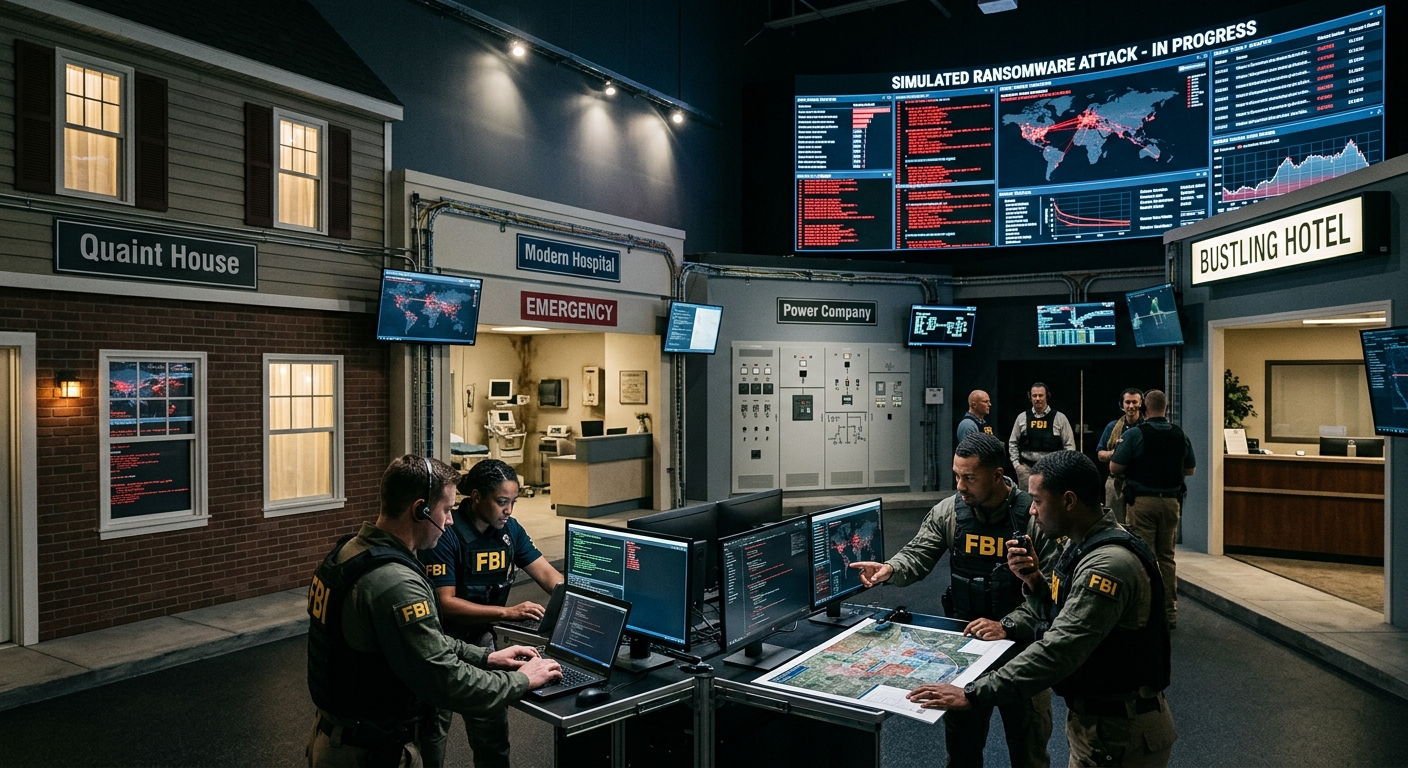
The FBI’s Kinetic Cyber Range is a state-of-the-art training facility that reproduces a small American town to simulate complex cyberattack scenarios. This immersive environment, located in Huntsville, Alabama, features realistic infrastructures, including homes, a hospital, and a power company, all equipped with operational networks that reflect real-world systems. The facility blends technical training with essential soft skills development to prepare agents for high-stress cyber incidents, such as ransomware attacks on critical infrastructure.
This innovation builds on the Bureau’s long-standing commitment to realistic training, evolving from physical crime scene simulations of the 1980s to a sophisticated approach addressing modern cyber threats. The Kinetic Cyber Range utilizes operational technology, industrial control systems, and enterprise IT networks, enabling multi-disciplinary exercises that provide insights into both technical and human aspects of cybercrime investigations.
Design and Features
The Kinetic Cyber Range includes over 200 physical servers and operational networks that replicate real-world environments, such as hospitals and businesses. The architecture supports the simulation of multi-stage cyberattacks, allowing trainees to experience realistic incident response situations. Role players, acting as business owners and legal personnel, enhance the training by focusing on the human aspects of cyber investigations, including communication and collaboration during crises.
This facility’s design prepares agents for the high-pressure decision-making seen in actual cyber incidents, emphasizing integrated training across digital forensics and cyber intrusion investigations. The realistic setup not only helps with technical readiness but also fosters essential teamwork and strategy among law enforcement members during cybercrime responses.
Training and Operational Workflow
The training approach at the Kinetic Cyber Range emphasizes real-time engagement with complex cyberattacks, encouraging agents to tackle both the technical and human elements involved. This scenario-based method allows for mistakes in a controlled setting, promoting effective learning through guided practice. Trainees simulate various incidents, such as ransomware attacks, while navigating realistic environments, including corporate and residential networks.
Additionally, the facility sharpens critical soft skills, such as communication and judgment under pressure. Through these realistic training simulations, agents become adept at responding swiftly while maintaining operational continuity, which is crucial for effective cyber incident management.
Tools and Technical Components
The Kinetic Cyber Range employs a variety of tools and technical components to create a realistic training environment. Its data center hosts over 200 servers running various operating systems, reflecting the diversity of real-world corporate infrastructures, while customized software facilitates digital investigation training. Specialized tools, including those for extracting data from encrypted devices, prepare agents to handle sensitive investigations, despite the controversies surrounding their methods.
Additionally, breach and attack simulation tools mirror real-world adversarial tactics, ensuring that security measures can be validated without exposing active systems to risk. This use of simulated environments enhances the relevance of training exercises, allowing teams to evaluate their security protocols and responses effectively.
Impact and Significance
The Kinetic Cyber Range signifies a notable advancement in the FBI’s training strategy, equipping agents with the skills necessary to address both real and hypothetical cyber threats. By fostering practical understanding of cyberattack impacts, personnel are better prepared for the urgency of real situations, such as ransomware incidents affecting critical services while maintaining public safety.
This immersive training emphasizes the dual importance of technical capability and soft skill development, helping agents learn crucial lessons in communication and strategic response. Furthermore, ongoing updates to training scenarios keep pace with evolving cyber threats, ensuring the preparedness of personnel against dynamic challenges in cybersecurity.
Challenges and Future Developments
As the Kinetic Cyber Range evolves, challenges remain around balancing training realism with operational constraints. Future enhancements will focus on integrating advanced technologies, like machine learning for threat detection, to augment training effectiveness. Incorporating real hardware into simulation scenarios will also provide nuanced perspectives on threats to critical infrastructure.
Moreover, the continuous adaptation of training scenarios reflects the FBI’s commitment to experiential learning, allowing agents to practice skills in a safe environment. With the introduction of sophisticated simulation tools, the Kinetic Cyber Range is poised to become an even more vital asset for cybersecurity preparedness, ensuring readiness against increasingly sophisticated threats.
The content is provided by Jordan Fields, 11 Minute Read